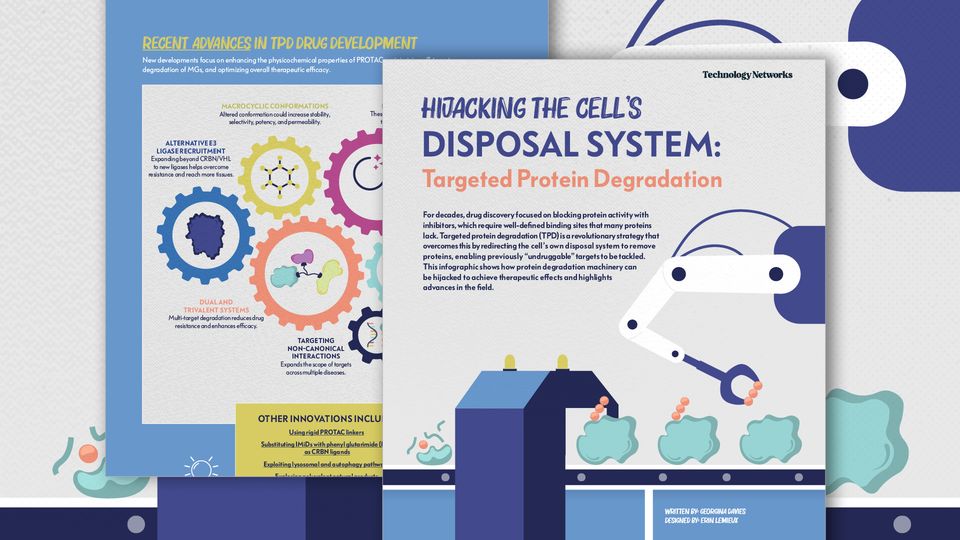
Previously, drug discovery has relied on inhibitors to block protein activity, yet many disease-associated proteins lack the binding sites needed for these approaches to succeed.
Targeted protein degradation (TPD) is transforming the field by harnessing the cell's own disposal machinery to selectively remove proteins, opening new opportunities to address previously undruggable targets.
This infographic explores the key modalities behind TPD, including molecular glues (MGs) and proteolysis targeting chimeras (PROTACs), and highlights the latest innovations advancing therapeutic discovery.
Download this infographic to discover:
- How TPD expands opportunities beyond traditional inhibition strategies
- The mechanisms behind MGs and PROTACs
- Recent advances improving selectivity, efficacy, and the range of degradable targets
Hijacking the Cell’s
DISPOSAL�SYSTEM:�
Targeted Protein Degradation
UnDrUgGaBlE PrOtEiNs
For decades, drug discovery focused on blocking protein activity with
inhibitors, which require well-defined binding sites that many proteins
lack. Targeted protein degradation (TPD) is a revolutionary strategy that
overcomes this by redirecting the cell’s own disposal system to remove
proteins, enabling previously “undruggable” targets to be tackled.
This infographic shows how protein degradation machinery can
be hijacked to achieve therapeutic effects and highlights
advances in the field.
CELLULAR MACHINERY
As part of their protein quality control system, cells use the ubiquitin–proteasome system to degrade unwanted
proteins. During this process, an E3 ligase binds to a target protein (TP) and mediates the transfer of ubiquitin onto
the TP via an E2 carrier, marking it for proteasomal degradation.
TPD leverages this pathway, recruiting the cell’s own machinery to tag pathogenic proteins for destruction.
Two major TPD modalities include molecular glues (MGs) and proteolysis targeting chimeras (PROTACs).
MOLECULAR GLUES
Pomalidomide
MGs are small molecules that bind to either the TP
or the E3 ligase, inducing changes that promote
protein–protein interactions between the ligase and TP.
This triggers the attachment of ubiquitin chains to the TP.
Three MGs are FDA-approved: thalidomide,
lenalidomide, and pomalidomide, all classed as
immunomodulatory imide drugs (IMiDs).
A classic example, thalidomide, was first marketed for
morning sickness in the 1950s and was soon withdrawn after
causing birth defects. It inspired the development of more
potent analogs, which are now used to treat multiple myeloma by
degrading transcription factors essential for cell proliferation.
Lenalidomide
Thalidomide
E3
MG
TP
PROTACs
PROTACs are heterobifunctional molecules, with each end binding
to either the TP or the E3 ligase to create a ternary complex.
The resulting proximity between the TP and E3 ligase drives
TP ubiquitination.
PROTACs have evolved from early peptide-based prototypes
to small-molecule candidates. In 2019, they entered clinical
trials for breast cancer.
MGs and PROTACs can also work in combination.
For example, thalidomide and its analogues have been
utilized as E3 ligase-recruiting ligands in PROTACs.
RECENT ADVANCES IN TPD DRUG DEVELOPMENT
New developments focus on enhancing the physicochemical properties of PROTACs, minimizing off-target
degradation of MGs, and optimizing overall therapeutic efficacy.
2001 Present
TP
E3
Virtual
screening
MG
ALTERNATIVE E3
LIGASE RECRUITMENT
Expanding beyond CRBN/VHL
to new ligases helps overcome
resistance and reach more tissues.
MACROCYCLIC CONFORMATIONS
Altered conformation could increase stability,
selectivity, potency, and permeability.
DUAL AND
TRIVALENT SYSTEMS
Multi-target degradation reduces drug
resistance and enhances efficacy.
HTS AND AI-DRIVEN DESIGN
These approaches could accelerate discovery
through prediction and optimization.
TARGETING
NON-CANONICAL
INTERACTIONS
Expands the scope of targets
across multiple diseases.
PHOTO-SWITCHABLE
DEGRADERS
Light-controlled, precise
degradation results in fewer
off-target effects.
OTHER INNOVATIONS INCLUDE:
Using rigid PROTAC linkers
Substituting IMiDs with phenyl glutarimide (PG)
as CRBN ligands
Exploiting lysosomal and autophagy pathways
Exploring polyvalent natural products
Repurposing non-degrading inhibitors
DELIVERY
METHODS
Nanoparticles, liposomes,
and targeted carriers
boost solubility and
tumor penetration.
Ubiquitin ligase complex
TP
Ub
E3 E2
WRITTEN BY: GEORGINA DAVIES
DESIGNED BY: ERIN LEMIEUX
TPD represents a transformative shift in drug discovery, moving beyond inhibition
to the selective removal of previously “undruggable” disease-causing proteins.
Innovations are addressing longstanding challenges and expanding the degradable
proteosome, paving the way for more effective, highly selective treatments across
a broad spectrum of diseases.
Proteasome