
Validating Raman Spectroscopy for Real-Time Release
A Raman spectroscopy-based tool can assess the quality and quantity of continuously flowing viral particles.
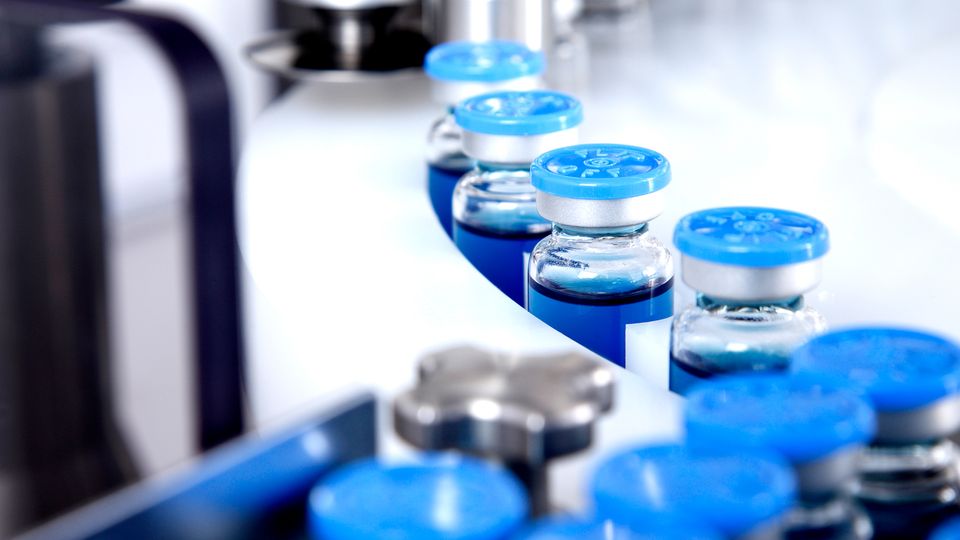
Pharmaceutical manufacturing has undergone a shift in recent years from traditional batch processing to continuous manufacturing (CM), where pharmaceutical products are produced end-to-end on a single, uninterrupted production line. Integrating process analytical technology (PAT) into CM allows manufacturers to monitor their products in real-time throughout the various production steps.
While CM has been employed in synthesizing active pharmaceutical ingredients for small molecule drugs, it remains largely untapped in large molecule manufacturing, including in vaccine production. One of the reasons for this is a lack of online control strategies; as such, there is a need for new PAT tools in this area.
Researchers from Purdue University and Merck & Co. Inc.* have validated a Raman spectroscopy-based tool that could help pharmaceutical companies boost vaccine production with rapid monitoring and analysis.
The tool, described in the journal Spectrochimica Acta Part A: Molecular and Biomolecular Spectroscopy, successfully measured the quality and quantity of continuously flowing viral particles.
Towards real-time release in vaccine manufacturing
The COVID-19 pandemic illustrated the need for new processing technologies that can enable the rapid, robust production of emergent vaccines at a considerably high dosage. Among strategies for process intensification, PAT would allow vaccine manufacturers to monitor their products in real time.
Existing analytical techniques for the quantification and characterization of viral particles, such as quantitative polymerase chain reaction and dynamic light scattering (DLS), are applied as at-line or off-line. The new Raman spectroscopy-based quality-control tool can operate on the production line, yielding results in 30 seconds or less. “It’s nondestructive in nature, and its ability to work with samples that have water makes it ideal for biological samples such as vaccines,” said Shreya Athalye, a graduate research assistant at Purdue University.
The US Food and Drug Administration's 2004 PAT guidance established the framework for building quality into processes through timely measurement rather than end-product testing, positioning in-line spectroscopic tools as instruments aligned with quality-by-design principles.
What is Raman spectroscopy?
Raman spectroscopy is a technique that involves illuminating a substance with a laser and analyzing the light scattered off the surface. This can provide a detailed molecular fingerprint of the substance's chemical components.

How Antibodies Reach Commercial Scale for Diagnostic Tests
This whitepaper follows an antibody's path to full production and shows where a contract partner can take on one step or the whole process.View Whitepaper
The researchers previously implemented Raman spectroscopy to detect and categorize bacteria, fungi, and mammalian cells with the help of machine learning. Building on this, the researchers used Raman spectroscopy to monitor the quality and quantity of human cytomegalovirus (CMV) particles in a continuous flow setup.
CMV is a member of the herpes family that primarily infects people with compromised immune systems, including those who receive transplants. “CMV structure and mode of action make the vaccine development challenging, but many investigational vaccines are being evaluated in clinical trials,” Athalye said.
The Raman-based system was validated at industrially relevant flow rates using human CMV as a model. The PAT tool enabled the detection of viral particles even at high flow rates such as 1000 μm/s with a limit of detection of 2.01 × 10¹⁰ particles/mL.
Viral particles were analyzed before and after exposure to the PAT tool using Sodium dodecyl sulfate-polyacrylamide gel electrophoresis and Western blot to ensure that there was no damage to the CMV samples. The researchers also used DLS to determine the effects of laser exposure on particle sizing. Results showed that the samples maintain their integrity even after exposure.
How to Accelerate Your Lab Operations With Modern LC Systems
This case study shows how one pharmaceutical laboratory cut total analysis time from more than 2 hours to 24 minutes by modernizing its methods.View App Note / Case Study
“To our knowledge, this is the first report of a Raman spectroscopy-based PAT tool for monitoring CMV particles. Our current work serves as a proof-of-principle to accelerate the efforts toward PAT development in large molecules,” explained the researchers.
Validating Raman spectroscopy methods for continuous manufacturing
Before a new PAT can be deployed in a Good Manufacturing Practice environment, the technology must undergo regulatory validation.
The analytical method validation requirements for Raman-based quantification models are governed by the ICH Validation of Analytical Procedures Q2(R2) guideline. The guideline encompasses multivariate spectroscopic methods, including Raman, covering specificity, accuracy, precision, and robustness testing requirements.
The updated Q2(R2) guideline is designed to be used alongside the companion ICH Q14 Analytical Procedure Development document. Together, they promote an ongoing, risk-based lifecycle approach.
The new Raman spectroscopy-based PAT tool was disclosed to the Purdue Innovates Office of Technology Commercialization, which has applied for a patent to protect intellectual property. Further development of the new PAT tool is also planned.
One study limitation was that sample evaluation was limited to the downstream stages of processing, which is relatively homogeneous. In future studies, the researchers aim to use microfluidics and acoustic concentration to improve the tool's sensitivity for heterogeneous samples.


Navigating Common Pitfalls in Gene Therapy Development
This webinar will explore lessons learned from previous development programs, including problems encountered by early researchers and the approaches used to address them.View Webinar
“We will also be demonstrating the potential of probe-based methods in delivering such results so that they could be integrated into continuous manufacturing unit operations,” said Dr. Mohit Verma, associate professor of agricultural and biological engineering at Purdue University.
“Continuous manufacturing is the future. It is environmentally friendly, and it saves money and resources as well. The critical component of continuous manufacturing is developing a robust quality-control tool, or more specifically, a process analytical tool. That’s what drives me to do this research,” concluded Athalye.
*Merck & Co. Inc. is also known as Merck Sharp & Dohme Corp. outside of the United States and Canada.
Reference: Athalye SM, Maruthamuthu MK, Esmaili E, et al. Real-time monitoring of attenuated cytomegalovirus using Raman spectroscopy allows non-destructive characterization during flow. Spectrochim Acta A Mol Biomol Spectrosc. 2026;345:126761. doi: 10.1016/j.saa.2025.126761
This article is a rework of a press release issued by Purdue University. Material has been edited for length and content.
 Add Technology Networks as a preferred Google source to see more of our trusted coverage.



