First-of-its-kind Commercial MicroED Solution Helps Researchers Quickly Resolve Organic and Inorganic Molecular Structures at Atomic Resolution
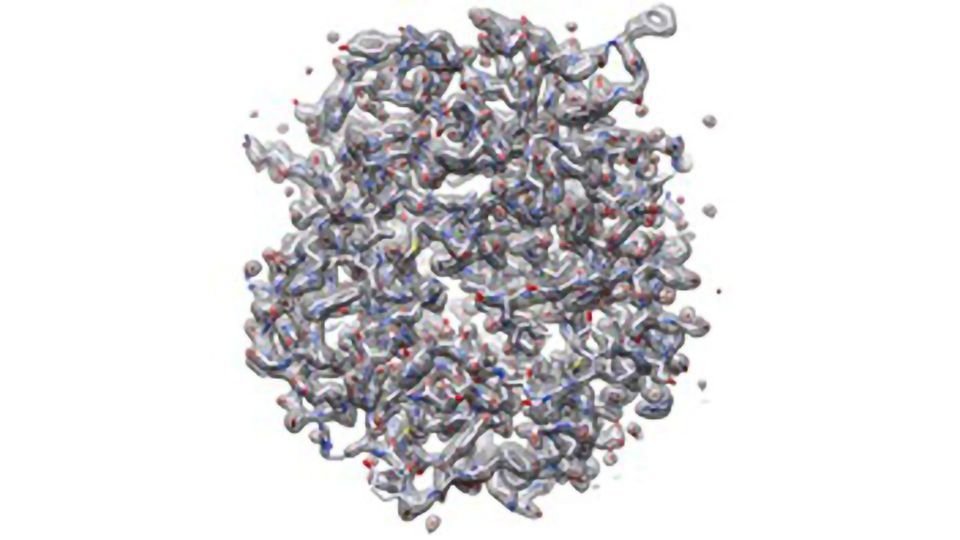
Proteinase K. MicroED data provided by the Gonen Laboratory HHMI/UCLA
Want to listen to this article for FREE?
Complete the form below to unlock access to ALL audio articles.
Read time: 1 minute
Researchers and scientists analyzing crystallized protein samples in life sciences and materials research can now benefit from the first commercially released integrated solution for performing micro electron diffraction (MicroED), an advanced technique that enables researchers to quickly resolve structures up to a billion times smaller than those needed using traditional methods.
The new Thermo Scientific MicroED solution, compatible with Thermo Scientific transmission electron microscopes (TEMs), enables scientists to perform analyses faster and with greater reproducibility than non-integrated MicroED offerings. The solution includes the CETA-D detector, optimized for diffraction imaging, and specialized MicroED software that automates the entire data acquisition process. The MicroED solution can be configured on multiple Thermo Scientific instruments, including Thermo Scientific Cryo-TEMs used in single particle analysis in life sciences and on high-resolution Thermo Scientific Talos and Themis TEMs commonly used in materials science research.
"We developed and then integrated a new detector and automation software into our leading high-performance TEM microscopes to offer customers unprecedented speed and ease-of-use for the MicroED technique," said Mike Shafer, president of materials and structural analysis at Thermo Fisher Scientific. "This solution allows researchers to accelerate innovation in key areas such as drug discovery and green energy advancements."
MicroED uses electrons to analyze crystallized protein samples previously too small and sensitive to observe with traditional x-ray diffraction methods. In life sciences research, this may reduce the time needed to develop new drugs or to confirm and improve the potency of existing drugs. In materials science, MicroED could be used to help speed creation of more efficient catalysts used in the reduction of harmful car or power plant emissions or in the development of new chemicals and fertilizers.
The new Thermo Scientific MicroED solution, compatible with Thermo Scientific transmission electron microscopes (TEMs), enables scientists to perform analyses faster and with greater reproducibility than non-integrated MicroED offerings. The solution includes the CETA-D detector, optimized for diffraction imaging, and specialized MicroED software that automates the entire data acquisition process. The MicroED solution can be configured on multiple Thermo Scientific instruments, including Thermo Scientific Cryo-TEMs used in single particle analysis in life sciences and on high-resolution Thermo Scientific Talos and Themis TEMs commonly used in materials science research.
"We developed and then integrated a new detector and automation software into our leading high-performance TEM microscopes to offer customers unprecedented speed and ease-of-use for the MicroED technique," said Mike Shafer, president of materials and structural analysis at Thermo Fisher Scientific. "This solution allows researchers to accelerate innovation in key areas such as drug discovery and green energy advancements."
MicroED uses electrons to analyze crystallized protein samples previously too small and sensitive to observe with traditional x-ray diffraction methods. In life sciences research, this may reduce the time needed to develop new drugs or to confirm and improve the potency of existing drugs. In materials science, MicroED could be used to help speed creation of more efficient catalysts used in the reduction of harmful car or power plant emissions or in the development of new chemicals and fertilizers.