
Could Proteins Become the Next Tool in Forensic Science?
Proteomics reveals forensic clues from biological traces that yield little or no usable DNA.
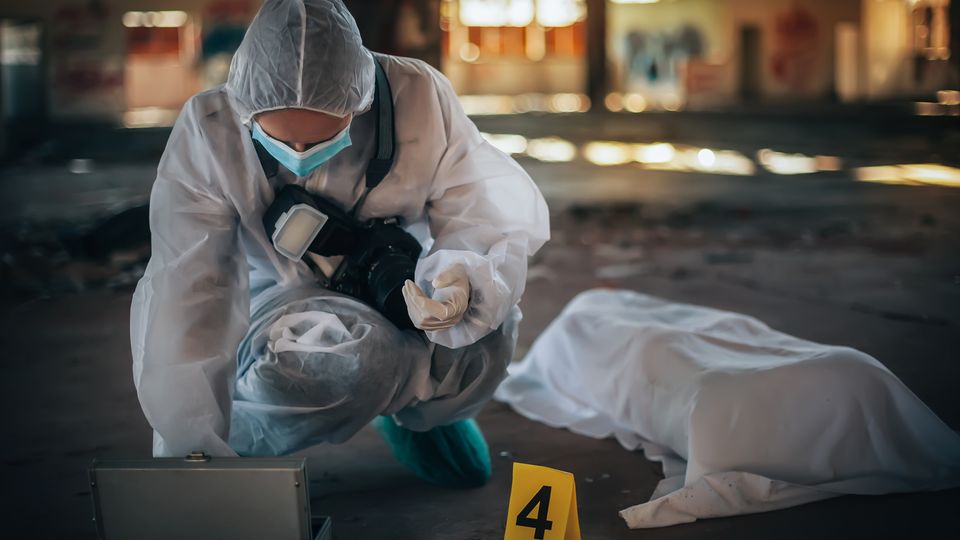
A strand of hair. A partial fingerprint. A decades-old bone fragment. Forensic investigators routinely recover biological evidence that contains little or no usable DNA.
In these cases, clues about a person's identity, their activities, or what happened at a crime scene can remain frustratingly out of reach.
Now scientists are starting to turn to a different source of information hidden within these traces: proteins.
The field of forensic proteomics uses mass spectrometry to identify and measure proteins within biological samples, revealing information that can complement traditional DNA analysis.
While DNA remains the gold standard for human identification, proteins are often more abundant, can persist for longer in challenging environments, and can provide contextual information that DNA cannot.
Recent advances in proteomics have also expanded the range of forensic questions researchers can address. As the technology continues to mature, scientists are exploring whether proteins could help investigators move past simply identifying who was present at a crime scene to understanding what happened there.
Technology Networks spoke with Dr. Marcel de Puit, the founder and chief executive officer of Cellation, and Dr. Glendon J. Parker, an adjunct professor of environmental toxicology at the University of California, Davis to learn more. They discussed the techniques driving the field, emerging forensic applications, and the challenges that must be overcome before proteomics becomes a routine part of forensic investigations.
The proteomics toolkit: bringing mass spectrometry into forensic science
Proteomics is the large-scale study of proteins, the molecules responsible for carrying out most biological functions within cells and tissues. While genomics focuses on DNA, proteomics examines the protein products generated from genetic information and how they vary between tissues, individuals, and physiological states.
This distinction makes proteins particularly attractive for forensic investigations.
Unlike DNA, which is broadly identical across many cell types within an individual, protein composition can differ depending on where a sample originated in the body. Proteins are also found in many forms of biological evidence, including hair, bone, fingerprints, and body fluids.
Many structural proteins can also remain detectable long after genetic material has degraded. Proteins contained within hair shafts, bone, and tooth enamel are protected by highly stable biological structures, making them particularly valuable targets when conventional DNA profiling fails.
Modern forensic proteomics typically begins with sample collection and protein extraction.
Proteins recovered from biological traces are digested into peptides and analyzed using liquid chromatography-tandem mass spectrometry (LC-MS/MS). Researchers can then compare the detected peptide signatures against reference databases to determine the biological origin of the sample or identify genetically informative protein variants.
Such approaches have allowed scientists to recover information from rootless hairs, degraded skeletal remains, and trace biological material that would previously have yielded little or no usable DNA.
Over the past decade, advances in mass spectrometry sensitivity, speed, and data analysis have significantly improved the practicality of these workflows.
“The sensitivity of mass spectrometry means that proteomics has minimal impact on the consumption of limited biological evidence,” said Parker.
The ability to work with tiny amounts of biological material is particularly important in forensic investigations, where evidence is often scarce.
Proteomics researchers employ several complementary approaches. Untargeted or shotgun proteomics surveys thousands of proteins simultaneously, allowing scientists to discover new biomarkers. Targeted methods focus on specific proteins or peptides of forensic interest, while quantitative approaches measure changes in protein abundance.
Next-Generation Analysis for Bioanalysis and Nitrosamines
Explore practical LC-MS/MS workflows for nitrosamine and NDSRI monitoring, impurity confirmation, and quantitative bioanalysis. Learn strategies for trace-level quantitation, compound identification, workflow efficiency, and compliance readiness.View Webinar
According to Parker, the field's rapid technological progress has transformed what is possible.
“Proteomics is a dynamic field and the technical advances over the last 10 years amount to a revolution,” he said.
These advances are allowing forensic scientists to recover valuable information from evidence once considered analytically inaccessible.
The growing forensic value of proteins
One of the earliest applications of forensic proteomics was bodily fluid identification. Different biological fluids contain distinct protein profiles, enabling researchers to distinguish between different fluids with greater specificity than many traditional tests.
In a recent study, researchers developed three complementary LC-MS/MS-based approaches to distinguish blood, saliva, semen, urine, and vaginal fluid from crime scene samples. The approach accurately identified pure body fluids and showed promise for complex mixtures.
However, the true potential of forensic proteomics may lie in situations where DNA struggles.
Parker and colleagues have helped pioneer proteomic genotyping, an approach that identifies genetically informative protein variants known as genetically variant peptides. As proteins can survive in samples where DNA is degraded, the method offers an alternative route to extracting individualizing information.
“There are about two-thirds of a million DNA-typing tests done a year in the United States; ~3–10% of these reactions could benefit from additional analysis when bringing these cases to court,” said Parker.


Bring Multi-Technique Analytical Data Into One Workflow
This app note illustrates processing, assignment, and reporting with examples from nuclear magnetic resonance, chromatography, mass spectrometry, and infrared spectroscopy.View App Note / Case Study
“There are also cases where DNA struggles to get usable information: sexual assault evidence, hair, degraded bone, and transfer evidence, such as finger marks. The residual genetic information in protein may have an impact here,” he added.
Most forensic hair samples lack a root, leaving investigators with little or no nuclear DNA to analyze. A recent study from Parker and his group developed a proteomic workflow capable of identifying the species origin of trace hair samples using peptide biomarkers detected by LC-MS/MS; the approach correctly classified all tested samples.
Proteins can also answer questions that DNA cannot.
“A case needs to provide human identification, but it also will need to know where the sample came from on the human body. DNA will not tell you that; all cells will have the same DNA. Protein composition and measurement will give that information. So, while proteomics can provide some genetic information, it will be most useful in providing needed context and doing so in a way that DNA cannot,” said Parker.
Beyond hair and body fluids, researchers have developed methods to analyze protein signatures in fingerprints and use tooth enamel proteins to estimate biological sex in archeological and forensic remains.
Collectively, these applications demonstrate the breadth of information encoded within the human proteome.
“We are definitively in an application phase to see where these new technologies will take us,” Parker said.
“There are extensive biological connections between the human proteome and forensic questions around traces and, in cases involving a victim, the human body. Proteomics may not necessarily provide the missing link or deliver the smoking gun, but it will guide investigators in the right direction: one more piece of the puzzle,” said de Puit.
Can proteins help reconstruct a crime?
While many current applications focus on identifying samples, some researchers envision a future in which proteomics contributes to a much broader forensic goal: event reconstruction.
Supporting Drug Discovery With Acoustic Ejection Mass Spectrometry
In this webinar, explore its application to native mass spectrometry screening and microsomal intrinsic clearance assays through two early drug discovery case studies.View Webinar
Rather than answering the question, “What is this sample?”, scientists hope proteins may eventually help address a more challenging one: “What happened here?”
De Puit describes this long-term vision as “ultimate event reconstruction.”
“I use that term for two reasons. First, proteins are understood to be far more stable than DNA and less affected by environmental factors over time, so information retrieved from proteins should hold up better as time passes. Second, the human proteome is tied to most, if not all, biological processes in the body and to human excretions such as sweat and blood, which gives it a very broad surface of potential forensic relevance,” de Puit explained.
That breadth creates opportunities to investigate biological processes associated with injury, disease, environmental exposure, or physical activity. Yet de Puit stresses that proteomics must always be interpreted within a forensic framework.
“Proteomics on its own is meaningless without a clear question or hypothesis in a forensic context,” he said. “In other words, if a difference in a human proteome is observed, it doesn't necessarily mean anything. The question is what triggered that change, and what does it mean in the context of a case.”
Proteomics is therefore unlikely to replace established forensic tools. Instead, researchers are viewing it as one component of a larger ecosystem.
“I think that the relationship between DNA, toxicology and/or fingerprints, and the human proteome is so vast that they will strengthen each other, rather than exclude each other, or compete with them,” de Puit said.
“DNA is a powerful source of forensic information because information capacity is so high and the variation across the human population provides easy resolution of human identity. Proteomics is powerful because proteins are so stable, and mass spectrometry is precise and sensitive. A well-balanced legal case needs both types of data,” added Parker.
However, significant challenges remain. Standardization, data interpretation, validation studies, and legal admissibility must all be addressed before forensic proteomics can achieve widespread operational adoption. Access to specialized instrumentation and expertise also remains a barrier.

Hybrid Metabolomics Now Standardized
Attendees will gain practical perspectives on bridging hypothesis-driven and discovery-based science to address a broader range of research questions.View Webinar
“The challenges are the same as for any other technical evidence type, the same ones DNA faced when it emerged: is it scientifically sound, peer-reviewed, and does it meet the legal admissibility bar?” de Puit said.
Forensic proteomics may be the last piece of the puzzle
Forensic proteomics is still an emerging discipline, but its potential is becoming difficult to ignore.
Advances in mass spectrometry and bioinformatics are enabling researchers to extract meaningful information from biological evidence that could help cases where DNA alone may not deliver all the answers.
Whether proteomics becomes a routine tool for event reconstruction remains to be seen.
“‘Ultimate event reconstruction’ is looking at the potential, not something proteomics delivers today; a lot of work remains,” de Puit warned.
For now, the technology is best viewed as a powerful companion to DNA, not as a replacement.
“Currently, only a few forensic labs routinely do proteomics, and only the Office of Chief Medical Examiner of the City of New York is bringing this to court. Within 10 years, proteomics will be a part of every forensic lab and part of the array of options investigators think about when they are figuring out how to get the most information out of a sample,” said Parker.
“We've only scratched the surface of what's potentially useful in proteomics for forensics,” de Puit added.
As proteomics continues its transition from research laboratories into forensic workflows, it may help turn previously unusable traces into meaningful evidence, giving investigators one more piece of the puzzle within a crime scene.
 Add Technology Networks as a preferred Google source to see more of our trusted coverage.



