
Scientists Recreate Spider-Man’s Web Fluid Technology With Liquid Silk
The liquid silk threads can stick to various objects and lift more than 80 times their own weight.
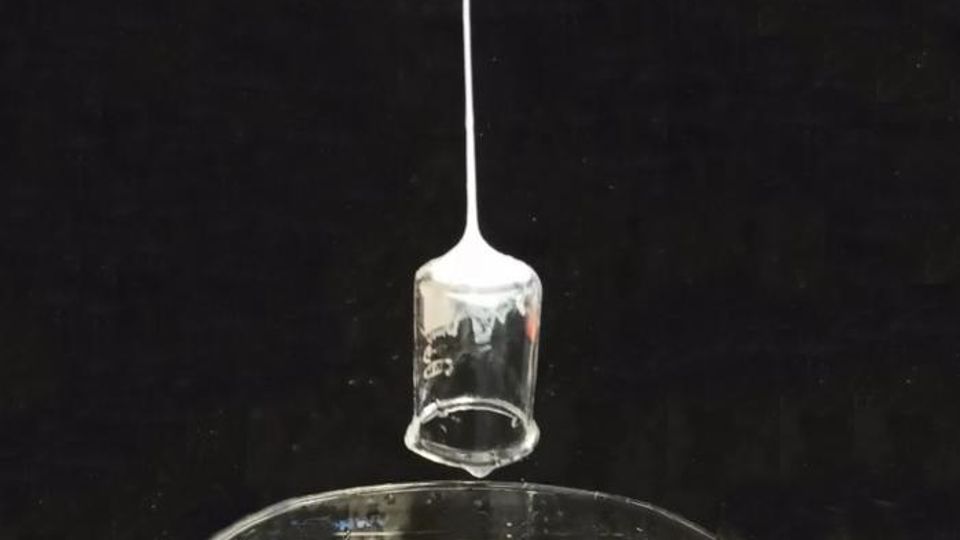
Don’t worry, Spider-Man, it’s not Doctor Octopus who has figured out the secret of your web-shooters—it’s researchers at Tufts University.
While working on a separate project involving extra-strong adhesives, the Tufts University Silklab team discovered that the silk from silk moth cocoons can be turned into a shootable, sticky protein solution that works surprisingly like Spider-Man’s famous web fluid.
The unique solution can be shot out of a needle, solidifying immediately into a sticky web-like fiber that can lift objects more than 80 times its own weight. Their research is published in Advanced Functional Materials.
Recreating Spider-Man’s web fluid
The main structural component of the web fluid is regenerated silk fibroin (Table 1). Fibroin is the load-bearing protein found in silk fibers and can be recovered from the cocoons of the domesticated silk moth Bombyx mori.
To prepare fibroin, silk cocoons are boiled to remove sericin, a glue-like protein that coats the fibroin filaments. The remaining fibroin is dissolved and processed into an aqueous solution.
This liquid silk provides a versatile starting material. Depending on its concentration, chemical environment, and processing history, fibroin can form films, gels, coatings, scaffolds, or fibers. Its ability to transition between soluble and solid states is central to the web fluid system.
Previous studies have shown that combining silk fibroin solutions with dopamine can result in very strong bioadhesives. Separately, it is also known that silk fibroin will begin to form a semi-solid hydrogel over several hours when mixed with organic solvents like ethanol or acetone.
The Tufts University researchers discovered that adding dopamine to their silk fibroin mix triggers solidification almost immediately, as dopamine pulls water away from the silk. This results in the formation of sticky silk fibers with a high tensile strength.
They also found that these fibers could be spun in the air by shooting them through a needle. The process of shooting the web fluid then occurs as follows:
- Immediately after leaving the needle, the thin stream of silk solution is covered by a layer of acetone.
- Acetone triggers fibroin aggregation and hydrogel formation.
- Controlled extrusion maintains the material as a connected strand.
- Acetone evaporates as the strand travels through air.
- The newly formed fiber remains sticky enough to bond to the surface it contacts.
“If you look at nature, you will find that spiders cannot shoot their web. They usually spin the silk out of their gland, physically contact a surface, and draw out the lines to construct their webs,” said Marco Lo Presti, a research assistant professor in biomedical engineering at Tufts University.
“We are demonstrating a way to shoot a fiber from a device, then adhere to and pick up an object from a distance. Rather than presenting this work as a bio-inspired material, it’s really a superhero-inspired material.”


Blot Like a Boss: Mastering Western Blotting
In this webinar, we troubleshoot the Western blot workflow, from sample preparation and electrophoresis through transfer, blocking, and antibody detection.View Webinar
By adding chitosan, a derivative of insect exoskeletons, and a borate buffer to the silk solution, the research group was able to further improve the fibers’ tensile strength by up to 200 times and their adhesiveness by around 18-fold.
In a composite hydrogel, chitosan can increase polymer-chain interactions and reinforce the network surrounding the silk proteins. Its amino and hydroxyl groups also provide numerous sites for hydrogen bonding and other intermolecular interactions. Borate ions can reversibly interact with catechol groups, modifying the cohesion, cross-linking density, and surface behavior of dopamine-containing materials.
The result is a thin fiber—with a diameter as thin as a human hair depending on the needle bore—that can pick up objects more than 80 times its own body weight. The team has demonstrated its flexibility by picking up a cocoon, a steel bolt, a laboratory tube floating on water, a scalpel partially buried in sand, and a wood block.
Table 1: The main components of the web fluid developed by the Silklab team.
| Component | Primary Function | Contribution to the Fiber |
| Regenerated silk fibroin | Structural protein | Forms the hydrogel fiber backbone |
| Dopamine | Adhesive and assembly-promoting molecule | Accelerates solidification and supports surface adhesion |
| Acetone | Nonsolvent and processing sheath | Triggers rapid fiber formation during extrusion |
| Chitosan | Polymer reinforcement | Increases tensile strength |
| Borate ions | Dynamic cross-linking agent | Enhances adhesive performance |
Measuring web fluid strength and adhesion
The optimized fibers reached tensile strength and adhesive strength values of up to 107 MPa and 280 kPa, respectively.
Tensile testing determines how a material behaves when pulled along its length. A fiber is clamped at both ends and extended at a controlled rate while a load cell records the applied force.

Modern Methods for Faster Microbial Analysis
Rapid microbial analysis is essential for maintaining product quality, ensuring safety, and supporting efficient laboratory workflows, yet selecting the most appropriate analytical approach can be challenging.View Webinar
Stress is calculated by dividing force by the original cross-sectional area. The maximum stress reached before failure is the tensile strength, while the accompanying extension provides information about strain and deformability.
Lap-shear testing evaluates the bonded interface. Two surfaces are joined over an overlapping area, and force is applied parallel to that interface until the bond separates. The maximum force divided by the bonded area gives the lap-shear strength.
These measurements distinguish two forms of failure that are important for deployable adhesive fibers. Cohesive failure occurs within the fiber or adhesive, whereas adhesive failure occurs where the material contacts the target. A useful retrieval system must resist both.
An accidental breakthrough
In nature, all manner of spiders, butterflies, moths, beetles, and even bees produce silk at some point in their lives to fulfill some kind of need—whether that be to build a web or a nest, or to produce a cocoon.
The Silklab researchers take inspiration from how silk fibers are deployed in nature and pioneer the use of silk fibroin in making powerful underwater adhesives, printable sticky sensors, edible coatings for perishable produce, novel light-collecting materials for solar cells, and more.
How liquid silk differs from spider silk
Spiders store concentrated protein formulations in specialized glands. As these proteins move through a spinning duct, changes in ion composition, pH, shear, and water content encourage molecular alignment and solidification. The silk is then drawn from spinnerets, typically after the spider attaches it to a surface.
Natural spider silk remains substantially stronger than the experimental fibers. Spider silk also achieves its combination of strength, elasticity, and toughness through highly organized protein structures that are difficult to reproduce using regenerated silk fibroin.

Smarter Cell Analysis With AI
In this infographic learn how AI-driven cell segmentation eliminates analyst-to-analyst variability and cognitive fatigue and scalable imaging workflows automate analysis across multiple multi-well plates simultaneously.View Infographic
Surprisingly, this latest discovery came about by accident while carrying out a separate project on adhesives.
“I was working on a project making extremely strong adhesives using silk fibroin, and while I was cleaning my glassware with acetone, I noticed a web-like material forming on the bottom of the glass,” Lo Presti said.
While scientists have previously created numerous adhesives inspired by animal silk or based on artificial silks, this is the first successful attempt at developing a material that can be instantaneously spun into adhesive fibers, the researchers said.
The current platform is a proof of concept rather than a ready-to-deploy retrieval tool. Nevertheless, remotely generated adhesive fibers could support applications in which conventional grippers, suction systems, or rigid manipulators are unsuitable.
“As scientists and engineers, we navigate the boundary between imagination and practice. That’s where all the magic happens,” said Fiorenzo Omenetto, Frank C. Doble Professor of Engineering at Tufts University and director of the Silklab. “We can be inspired by nature. We can be inspired by comics and science fiction. In this case, we wanted to reverse engineer our silk material to behave the way nature originally designed it, and comic book writers imagined it.”
This article is a rework of a press release issued by Tufts University. Material has been edited for length and the content has been updated to provide additional context and details of related developments since the original press release was published on our website. This content includes text that has been created with the assistance of generative AI and has undergone editorial review before publishing. Technology Networks' AI policy can be found here.
 Add Technology Networks as a preferred Google source to see more of our trusted coverage.



