
New RNA-Editing Tool Could Make Gene Therapies Safer
Yale researchers have created a new RNA editing tool that can take some of the risk out of gene therapy.
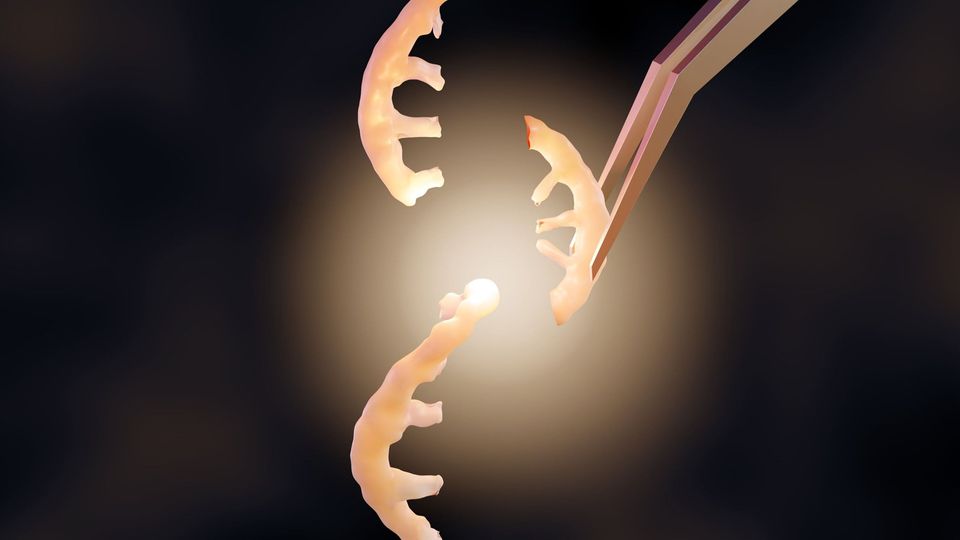
The ability to correct disease-causing genetic mistakes using genome editors holds great promise in medicine, but it is not without risk. When this type of “genetic surgery” is performed on DNA, for instance, there is always the danger of leaving permanent genetic scars that may even be heritable.
To alleviate this risk, researchers have experimented with gene editing processes on messenger RNA (mRNA), a central link between DNA and proteins that doesn’t carry the same risks because it doesn’t involve permanent changes to the DNA. But existing RNA editing tools have proven either too cumbersome to use or too toxic to human cells.
Yale researchers have developed a new — and safe — family of RNA-editing tools that utilize an RNA-targeting activity that they found “hidden” inside a popular gene editing tool known as CRISPR-Cas9.
“The solution was surprisingly simple,” said study lead author Ailong Ke, professor of molecular biophysics and biochemistry at Yale School of Medicine and a member of Yale’s Faculty of Arts and Sciences. “We discovered robust RNA-targeting activity hidden inside [the CRISPR tool] and its related enzyme, IscB, and simply unleashed its hidden power to target RNA.”
Their findings were published in the journal Cell.
CRISPR (clustered regularly interspaced short palindromic repeats) are DNA sequences found in the genomes of organisms — such as bacteria and archaea — whose cells lack a nucleus and other membrane-bound organelles. Cas9 (CRISPR-associated protein 9) is an enzyme that uses CRISPR sequences. Cas9 enzymes and CRISPR sequences form the basis of the CRISPR-Cas9 technology used to edit genes in living organisms.
The approach was guided by “a deep understanding of the molecular structures of IscB,” including findings reported by the lab in the journal Science, said Chengtao Xu, a postdoctoral associate at Yale and first author of the study.
“It would be much harder to come up with the same idea from Cas9, because its structure is way more sophisticated than IscB.” said Xu. “Nature leaves a lot of treasures for us, and it’s challenging but intriguing to reveal them. This is something we’re particularly good at in molecular biophysics and biochemistry.”
Researchers named their new tools R-IscB and R-Cas9 and defined their usage in genome research and medicine.
“They are the Swiss army knives for RNA editing,” Ke said. “We show that they can be used to perturb mRNA functions, to slice and destroy the targeted mRNA, or to correct the coding mistakes in the mRNA target.
“In essence, we have a way to perform any type of genetic surgery at the RNA level, which is a big deal.”
Xu added that the tools worked just as well on the enzyme Cas9 targets, which use CRISPR sequences. “We’re really excited to see how far we can take this approach with other similar tools,” he said.
Researchers now plan to test the tools in the lab to cure rare genetic diseases or to promote wound healing.
“We’re particularly excited about the trans-splicing reactions performed by the R-IscBs, because it can potentially correct any type of genetic mutations at the RNA level. This is a huge opportunity for genome medicine,” Ke said.
“There are a lot of potential applications. The new tool is robust, very precise, and quite versatile.”
Reference: Xu C, Niu X, Sun H, Yan H, Tang W, Ke A. Conversion of IscB and Cas9 into RNA-guided RNA editors. Cell. doi: 10.1016/j.cell.2025.07.032
This article has been republished from the following materials. Note: material may have been edited for length and content. For further information, please contact the cited source. Our press release publishing policy can be accessed here.
 Add Technology Networks as a preferred Google source to see more of our trusted coverage.

