
Simulations Could Help Predict and Improve Antibody Drug Formulations
The goal is for patients to be able to administer these medications themselves at home.
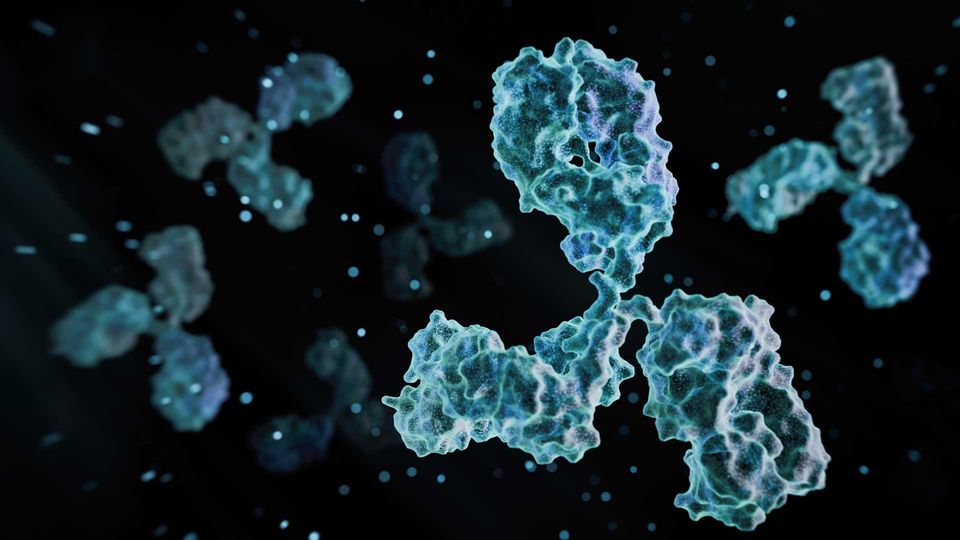
Monoclonal antibodies (mAbs) aid the body against autoimmune diseases and cancer, among other things. Patients have to pick up the medicine every few weeks. It would be easier for them to be able to inject the medicine themselves at home, but this would only be possible if the medications were highly concentrated but not too viscous. A team at Ruhr University Bochum, Germany, led by Professor Lars Schäfer from the Center for Theoretical Chemistry and the company Boehringer Ingelheim Pharma have developed a quick and realistic simulation method to make this possible. This method can predict how formulations will behave. The team reports its findings in the Journal of Physical Chemistry from December 7, 2025.
More viscous than olive oil
When administering an antibody medication subcutaneously, no more than two milliliters can be injected per syringe. This small quantity must contain a very high level of antibodies in order for the medication to be effective. This makes the medication highly viscous. “It is not uncommon for the viscosity to be higher than that of olive oil, which can make subcutaneous injection very difficult,” says Schäfer. “This challenge has complicated the development and application of biopharmaceutical formulations for a long time.”
Until now, improving these formulations has largely relied on trial and error – testing countless combinations of ingredients and conditions, which is both time-consuming and resource-intensive. “We thus set out to use chemically realistic computer simulations to predict the consistency of various formulations,” says Dr. Tobias Prass from the Center for Theoretical Chemistry, first author of the publication. The researchers developed a coarse-grained simulation approach that is far more efficient yet still captures the key chemical interactions.
“Our approach is around a thousand times faster than atomistic simulations, while closely matching experimental results,” explains Prass.
Saving time and resources
“The simulations not only complement and explain our experimental findings”, adds Dr. Michaela Blech from Boehringer Ingelheim Pharma GmbH & Co. KG. “They also enable the rational design of new experiments and can predict their outcome, saving time and resources by filtering out unpromising candidates and conditions early in development.”
Reference: Prass TM, Garidel P, Blech M, Schäfer LV. Predicting the dynamic viscosity of high-concentration antibody solutions with a chemically specific coarse-grained model. J Phys Chem Lett. 2025;16(50):12758-12765. doi: 10.1021/acs.jpclett.5c03003
This article has been republished from the following materials. Note: material may have been edited for length and content. For further information, please contact the cited source. Our press release publishing policy can be accessed here.
 Add Technology Networks as a preferred Google source to see more of our trusted coverage.

