
How Do We Tackle the Biggest Challenges Facing Oncology?
Cancer Grand Challenges unites international and interdisciplinary researchers to address complex problems in cancer.
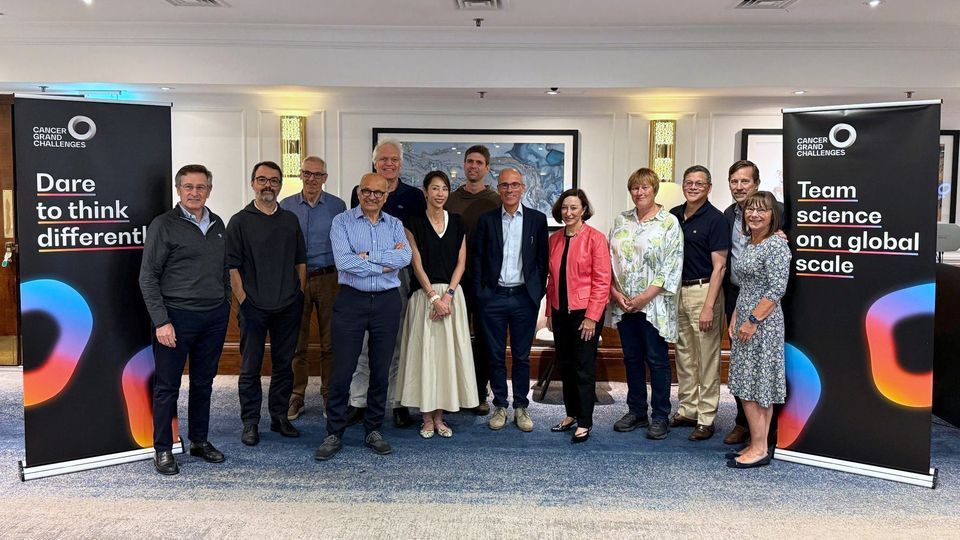
How do researchers begin to tackle the toughest challenges in cancer research?
Answering the big questions in oncology, such as: why do some people never develop cancer, despite being at high risk? How does the nervous system influence cancer growth? Or what actually causes cancer-associated DNA mutations? requires a gargantuan, global effort.
Often, progress against cancer is impeded by complex research problems that no single researcher, institution, or country can overcome alone.
Cancer Grand Challenges, a global research initiative co-founded by Cancer Research UK and the National Cancer Institute, aims to identify the most complex problems in oncology and build an international, interdisciplinary community to tackle them.
By funding teams to address specific challenges, Cancer Grand Challenges hopes to profoundly reshape how we understand, prevent, and treat cancer.
To find out what makes a “grand challenge” in oncology, how the funded challenges are chosen, and the impact of the Cancer Grand Challenges initiative so far, Technology Networks spoke to Professor Sherene Loi, a medical oncologist at the Peter MacCallum Cancer Center and a member of the Cancer Grand Challenges Scientific Committee.
Katie Brighton (KB): What do you think makes a scientific problem a true “grand challenge” in cancer research, rather than simply an important unanswered question?
Prof. Sherene Loi (SL): A true Cancer Grand Challenge is a question that has the potential to fundamentally transform the way we think about cancer. These are deliberately bold, ambitious challenges that address a fundamental barrier to progress and, if solved, could reshape our understanding of cancer, improve outcomes for patients, or even open up entirely new classes of therapy. Ultimately, we are looking for questions whose answers could redefine the direction of cancer research.
Cancer Grand Challenges: The latest
Earlier this year, the initiative announced that $125 million was awarded to five research teams:
- ATLAS—to investigate why certain people remain cancer-free despite strong genetic or environmental risk factors.
- CAUSE—to identify the environmental and biological origins of cancer mutations.
- ILLUMINE—to understand how the dark proteome influences cancer biology, and how it could inform the discovery of new therapeutics.
- InteroCANCEption—to decode how the nervous system influences cancer growth, spread, and immune responses.
- REWIRE-CAN—to reprogram cancer cells to disadvantage the tumor, offering a different approach to cancer therapy.
The teams were selected for their innovative approaches and wide-ranging expertise that could shed light on some of the biggest challenges facing the field.
KB: Can you tell us a little about how the Cancer Grand Challenges are chosen? What are you looking for scientifically, and what excites you most about a potential challenge?
SL: We don’t decide the next Cancer Grand Challenges from behind closed doors. We always listen to people around the world about the questions they believe could make the biggest difference to cancer research. That’s why the challenge-setting process is built around consultation, with think tanks bringing together scientists, clinicians, and people from a wide range of backgrounds. These discussions are now underway across eight meetings as we identify the next generation of Cancer Grand Challenges.
It’s a rigorous challenge-setting process that involves patient advocates to help shape the final wording of each challenge articulation, ensuring it reflects the experiences and priorities of people affected by cancer. What excites me most is the possibility of uncovering a question that nobody has yet been able to answer, but that could unlock a completely new approach.
One Platform, Many Omes: Scaling Spatial Transcriptomics Research Across Diverse Applications
This webinar explores how spatial transcriptomics enables single-cell resolution analysis while preserving tissue context.View Webinar
Cancer Grand Challenges: New challenges
Last month (September 2026), two new targeted challenges focused on gastroesophageal cancer were launched, with applications open to the global research community. One focuses on the early tissue changes that lead to gastroesophageal cancers, and the other aims to determine the biological mechanisms that create global variation in this cancer type.
KB: Why is interdisciplinary and international team science so important for delivering transformative advances in cancer research?
SL: Cancer is not one disease, and it certainly isn’t something that can be solved from one perspective or one country.
“Because cancer is a global problem, we need a global response.”— Prof. Sherene Loi.
Bringing together expertise from different disciplines, countries, and backgrounds gives us a much better chance of asking the right questions in the first place—and those questions are the starting point for transformative research.
Cancer affects people across the world, across different populations and ethnicities, and we’re seeing problems such as the rise in early-onset cancers. Set in 2023, this challenge is being investigated by team PROSPECT, which is taking an interdisciplinary approach to understand the underlying causes and mechanisms driving the rise in early-onset colorectal cancer. The team brings together experts in population sciences, clinical trials, behavioral science, genomics, cancer biology, and nutrition.
The Bigger Picture: Combining Mass Spectrometry and Proximity Extension Assay
This webinar will explore how mass spectrometry (MS) and proximity extension assay (PEA) technologies can be used together, providing practical guidance for designing and analyzing integrated proteomics studies.View Webinar
“To make real progress, we need to look at cancer from every possible angle.”— Prof. Sherene Loi.
That means bringing together people who think differently—including researchers who aren’t traditionally part of the cancer field. Sometimes the breakthrough comes from bringing a completely new way of thinking to a problem.
KB: Can you give an example of a Cancer Grand Challenges project in which bringing together researchers, data, or resources from different countries and disciplines made something possible that could not have been achieved by a single institution?
SL: A good example is the kind of work being undertaken by our Cancer Grand Challenges teams to tackle questions that sit at the intersection of different fields. Take team MATCHMAKERS, for example, which is bringing together expertise in immunology, cancer biology, computational science, and artificial intelligence to understand how T cells recognize cancer.
The challenge is enormous: there are potentially millions of different interactions between T-cell receptors and cancer cells, and understanding this recognition code could help us identify which T cells are capable of recognizing and attacking cancer.
No single laboratory or discipline has all the expertise, data, or technologies needed to tackle a problem of that scale. By bringing those capabilities together across a global team, Cancer Grand Challenges creates the environment to ask a much bigger question—and to develop approaches that could ultimately change how we diagnose, prevent, and treat cancer.
One-Step Cleanup for Single-Cell RNA Sequencing of Human Tumor Tissue
This app note measures cell and sequencing quality in fresh ovarian tumor samples. It then tests cryopreserved samples, where the magnetic protocol saved 25 min.View App Note / Case Study
That is really the power of the model: bringing together people and ideas that would not necessarily have come together otherwise, and giving them the scale and freedom to tackle problems that are simply too big for one institution.
KB: Looking across the funded teams so far, which discovery or shift in scientific thinking do you think best demonstrates the impact of the Cancer Grand Challenges approach, and why?
SL: Team NexTGen is a powerful example of how the Cancer Grand Challenges approach can help tackle some of the toughest problems in cancer. Solid tumors in children and young people have proved stubbornly difficult to treat, and the team is working to change that by developing more effective treatment approaches that are more tailored to children and their unique biology.
NexTGen is working to change this through a coordinated program of clinical studies across the United Kingdom and United States, bringing together expertise, research infrastructure, and patients to test new approaches to CAR T-cell therapy. This international collaboration creates opportunities to evaluate treatments across a wider group of patients, while connecting clinical studies with ongoing laboratory research to help refine and improve these approaches as the work progresses.
“It’s this combination of ambitious science, international collaboration, and an iterative approach to research that we can bring to this bold mission.” — Prof. Sherene Loi.
How AI Is Transforming the Way We Edit Genes
This application note reports on the testing of five AI-generated adenine base editors in iPSCs, HSPCs, and T cells, including results showing up to 80% A-to-G editing efficiency with minimal optimization.View App Note / Case Study
International partnership is vital, and team NexTGen is well placed to push the boundaries of what’s possible, building on its findings to help develop better treatments for children with cancer.
KB: What do you think success for Cancer Grand Challenges looks like over the next decade, both for cancer science and patient outcomes?
SL: Success means turning some of the biggest unanswered questions in cancer into breakthroughs that change people's lives.
Over the next decade, I want to see the questions we are asking today lead to completely new ways of understanding and treating cancer—new therapeutic approaches, new ways of identifying who is at risk, and new strategies for preventing or detecting cancers earlier.
I also think success is about changing the way cancer research itself is done. We want to see researchers from different disciplines and different parts of the world continuing to work together, bringing new ideas into cancer research and tackling problems that no single group could solve alone.
If, 10 years from now, we can look back and say that Cancer Grand Challenges helped answer questions that once seemed almost impossible—and that those answers have led to better outcomes for patients—that would be a tremendous measure of success.
Our ambition is simple: to take on the questions that are too big, too complex, or too difficult for anyone else to tackle, and turn them into progress for people with cancer.
 Add Technology Networks as a preferred Google source to see more of our trusted coverage.



