
Cell Mapping Tool Provides Detailed Insights Into Cancer Cell Behavior
A new computational tool could help understand the complex relationships between tumors and their surrounding cells.
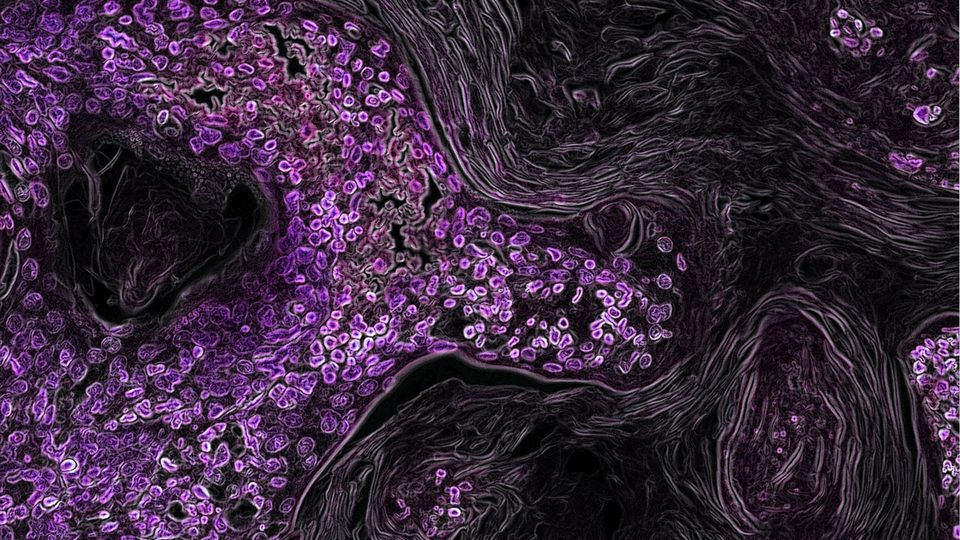
Researchers at VCU Massey Comprehensive Cancer Center have developed a new computational tool called Vesalius, which could help clinicians understand the complex relationships between cancer cells and their surrounding cells, leading to potential discoveries regarding the development of hard-to-treat cancers. Findings from a new study—published last week in Nature Communications—could help guide the identification of predictive biomarkers for multiple cancers and better inform the effectiveness of different treatment options based on individuals’ specific type of disease.
Rajan Gogna, Ph.D., member of the Developmental Therapeutics research program at Massey and assistant professor in the VCU School of Medicine’s Department of Human and Molecular Genetics, and a team of collaborators were driven by the goal of interpreting extensive amounts of data in a meaningful way.
While other computational cell-mapping tools have been used in cancer research for many years, Vesalius is the first that reveals which genes are active in each individual cell.
“With Vesalius, we are using artificial intelligence to find the spatial patterns in the whole tissue architecture among patients who respond to therapy and those who don’t,” said Gogna. “It’s creating a territory of informational domain.”
Named after Andreas Vesalius, the sixteenth-century Belgian anatomist and physician who studied human anatomy at the preliminary stages, this tool sets out to understand the physiology of tissue architecture from a more advanced perspective.
The research team’s approach is to analyze the whole tissue rather than individual parts due to the dormant nature of cancer cells. Since cancer cells often live alongside surrounding cells for many years in patients, they will inevitably influence each other.
“Take a husband and wife who have been married for 20 years. If you are meeting with either one of them individually, can you see the influence of the other partner somewhere in your interaction?” Gogna said. “A fibroblast—a type of cell involved in the production of connective tissue—is not only interacting with a cancer cell. These cells are sitting with their neighbors from the time the cancer originates. So, to treat them as individual cells is wrong. They are influenced partners.”
Bridging the divide
To track the immense amount of data about the influential relationships between cancer cells and their surrounding cells, the team needed a tool that could not only store that data but also help draw meaning from it.
“The data is getting more and more vast, and there’s a great need to make sense of that data,” said Gogna. “That’s why we started working on Vesalius six years ago. You have to consolidate it.”
By examining cancer cells, T cells and macrophages as a network of interacting cells, researchers can begin to identify patterns that emerge in those cancer samples, refine their treatment protocols and gain more confidence in the treatments they offer patients.
“For me, it’s very important to see cancer holistically as an entity trying to interact with the body,” said Gogna. “We claim that there is an evolutionary war between these two, and both are very smart. But cancer is smarter, because it’s winning in certain cases.”
Looking ahead
Moving forward, Gogna plans to implement the tool on larger datasets and collaborate with multiple networks of institutions.
“We want to create specific categories of clinically relevant questions from large AI models applied on large data sets,” Gogna said. “We can start asking questions for cancers where there are typically poor outcomes, such as pancreatic cancer.”
Since its creation, Vesalius has primarily been tested on breast, colon and ovarian cancers, but there is potential to apply the tool to all cancers in the future. As information is gathered on a broader scale, the AI model will continue to train itself and help clinicians tweak their protocols.
“Artificial Intelligence like Vesalius will have a significant impact on the future of cancer research and patient outcomes because of the scientific foresight of researchers like Dr. Rajan Gogna,” Robert A. Winn, M.D., director and Lipman Chair in Oncology at Massey, and co-author of this research, said. “Massey continues to close the gap with tools like Vesalius leading to better health outcomes and reducing the cancer burden for all.”
Reference: Martin PCN, Wang W, Kim H, et al. Multi-scale and multi-context interpretable mapping of cell states across heterogeneous spatial samples. Nat Commun. 2025;16(1):7814. doi: 10.1038/s41467-025-62782-y
This article has been republished from the following materials. Note: material may have been edited for length and content. For further information, please contact the cited source. Our press release publishing policy can be accessed here.
 Add Technology Networks as a preferred Google source to see more of our trusted coverage.

