
Pancreatic Cancer Cells "Speak the Language" of the Cells They Invade
As they develop, pancreatic cancer cells express the genes that will determine where they metastasize.
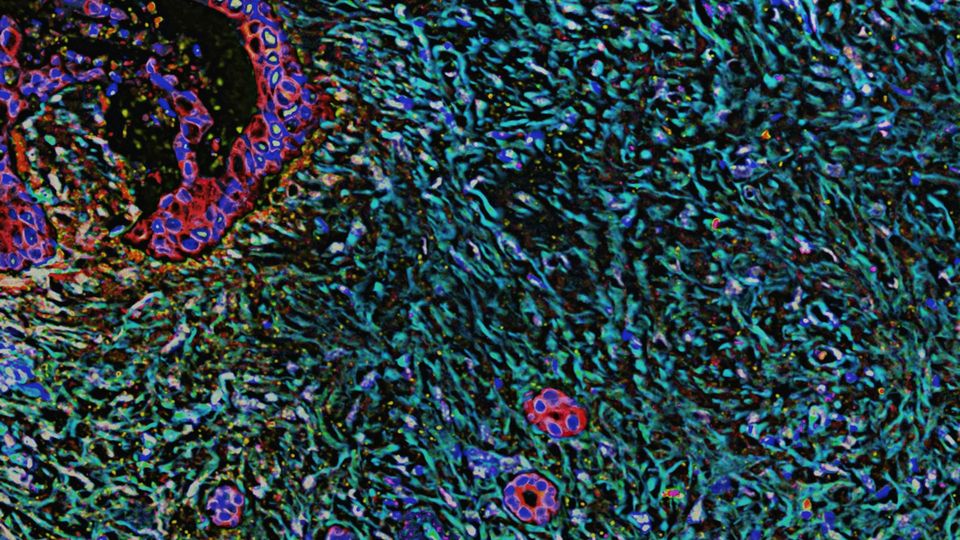
Even as they develop at their primary site, pancreatic cancer cells are already expressing the genes that will determine where they will metastasize, according to new findings from Columbia researchers. The work, published in Nature Genetics, reveals a new facet of cancer metastasis, and points toward novel strategies for anticipating and blocking this deadly phenomenon.
The project began a decade ago, when Gulam Manji, MD, PhD, co-leader of the Precision Oncology and Systems Biology research program at the Herbert Irving Comprehensive Cancer (HICCC), was struck by the dramatic differences in prognoses for pancreatic cancer patients. People whose tumors metastasized to their lungs alone did far better than those with liver metastases.
“It was very gratifying to see patients with lung only metastasis doing very well, yet at the same time really frustrating as an investigator, because there was biology within them that we didn’t really understand,” says Manji.
Clearing the hurdles
Columbia maintains a large repository of tumor specimens, but the experiment Manji had in mind required detailed clinical annotation of each sample. Enlisting the aid of collaborators, students, and postdocs, he had his team sift through several hundred cases, eventually finding 131 patients with isolated metastases of pancreatic tumors to either lung or liver.
The next challenge was analyzing the tumor specimens, which often contain mixed populations of cancer cells and normal cells of the immune system and adjacent tissues. To study them, the researchers developed new methods for single-nucleus RNA sequencing and whole genome sequencing, obtaining detailed data on individual cells’ gene expression patterns. Benjamin Izar, MD, PhD, member of the HICCC’s Tumor Biology and Microenvironment research program, led the computational biology side of the project, extracting and validating findings from the deluge of sequencing data.
Using a suite of new technical and analytical advances, and by integrating several other data sets, Izar’s group stumbled over an interesting observation.
“Cancer cells from patient’s primary tumours that ended up relapsing in the liver or the lung early on adopt cellular states that resemble their ultimate target organ. In other words, they already spoke the right language to ultimately fit in into their future organ community,” says Izar.
Even at their primary site in the pancreas, the tumor cells are already impersonating cells of their destination organ, predisposing them to survive there. A key question was whether a specific change in the DNA caused this observation. The researchers applied machine-learning approaches and studied additional large patient data bases to try to find an answer.
“We could not identify a single genetic event that could explain tropism to either liver or lung. While we have to remain open to alternative explanations, so far, we could not find a genetic reason for this intriguing result,” Izar says.
The researchers also looked at cultured cells from other types of cancers and found conserved signatures suggesting the same sort of metastatic foresight. “The key question now is what is the switch that takes these cells through these different programs?” says Manji.
While stressing that the results still need to be validated by other researchers and on more samples, Manji is excited about the effect they could have on patient care. In the near future, he hopes physicians will be able to refine surveillance strategies by predicting where a tumor is likely to metastasize. Looking further ahead, the gene expression profiles may point toward novel drug targets.
“Within the predictive signatures are likely embedded, determinants that allow these tumors to successfully establish a metastatic niche. Disrupting these key determinants is the next challenge which will likely produce a personalized drug for liver metastasis,” says Manji.
Reference: Chalabi Hajkarim M, May M, Amin AD, et al. Cellular states associated with metastatic organotropism and survival in patients with pancreatic ductal adenocarcinoma. Nat Genet. 2025;57(11):2728-2742. doi: 10.1038/s41588-025-02345-5
This article has been republished from the following materials. Note: material may have been edited for length and content. For further information, please contact the cited source. Our press release publishing policy can be accessed here.
 Add Technology Networks as a preferred Google source to see more of our trusted coverage.

