
Accessibility, Sustainability, and Automation: The Future of Mass Spectrometry
Discover how an increased focus on sustainability and throughput is shaping the future of mass spectrometry.
As mass spectrometry technologies become more powerful, laboratories face a growing challenge: how to make advanced analytical capabilities accessible to a broader range of users while simultaneously improving sustainability, productivity, and data quality. These pressures are particularly acute in sectors such as biopharma, environmental testing, and quality control, where demand is high for simpler, more automated workflows.
Recently, Agilent Technologies introduced several new products designed to address these challenges, including the 9500 triple quadrupole inductively coupled plasma mass spectrometry (ICP-MS) system, two new gas chromatography (GC) platforms—the Agilent 8890B and 8860B—and a multi-attribute method (MAM) solution designed to support liquid chromatography–high resolution mass spectrometry (LC/HRMS) testing in pharmaceutical and biopharmaceutical quality control laboratories.
Technology Networks sat down with several Agilent leaders to discuss these launches, as well as their view on accessibility, sustainability, and the future direction of mass spectrometry.
Featuring insights from Dr. Iris Mangelschots, vice president and general manager of Agilent's liquid phase division, Dr. Shane Tichy, associate vice president of LC/MS research and development, Geoff Winkett, vice president and general manager of the spectroscopy and vacuum division, and Warren Potts, vice president and general manager of the gas phase division, the conversation revealed several key themes shaping the next generation of mass spectrometry: simplifying complex technologies, reducing laboratory environmental impact, enabling automated quality workflows, and preparing for increasingly data-driven laboratories.
Improving accessibility in advanced mass spectrometry workflows
How important is improving accessibility in mass spectrometry as techniques become increasingly advanced?
A recurring theme across Agilent's launches was the effort to lower barriers to adoption for sophisticated analytical technologies. While triple quadrupole systems deliver significant performance advantages, some laboratories still perceive them as more difficult to operate than traditional single-quadrupole instruments. According to Agilent, customers increasingly want access to advanced analytical performance without additional complexity.
"What they're telling us is we want that performance, but you need to make it easy for us to use, and that was front of mind for our R&D teams [for the 9500 TQ ICP-MS], both in terms of tuning the hardware and also in the software interface that our customers are using to operate our systems," Winkett said.
In addition to having a very visual and element-focused interface, the system also features a wizard that helps first-time users develop methods from scratch. Having these kinds of accessibility tools is important, Winkett explains, as mass spectrometry becomes increasingly accessible to a broader range of users across industries, rather than being limited to specialist PhD-trained chemists.
"Traditionally, the people using our instruments were PhDs and very, very experienced. But that is changing. If you go into an environmental lab now, they have many different operators who are really [focused] on getting these jobs done quickly."
This is a sentiment echoed by Potts, who added that these accessibility features can also help to make maintenance operations more efficient. "From a GC point of view, just keeping these instruments running and doing your regular maintenance, you would need to run off and try to find a manual, which is not hugely helpful," he said. "If you can remain at your instrument and watch a video that shows you what to do, you're done faster."
The two new GC instruments—the 8890B and 8860B—both feature GC Assist, a new instrument intelligence feature that offers built-in troubleshooting, diagnostics, and system monitoring that can continuously assess performance, gas and power usage, and indicate potential signs of carrier gas leaks. Collectively, this helps labs reduce unplanned downtime and helps their scientists identify issues earlier and faster.
"We are always hearing from customers that things need to be simpler—more accessible—because it helps them do their jobs better," Potts added.
Key accessibility takeaways:
- Advanced analytical performance increasingly needs to be paired with intuitive workflows.
- Automation and workflow guidance help support a broader range of laboratory users.
- Instrument accessibility is becoming a critical purchasing criterion across multiple industries.
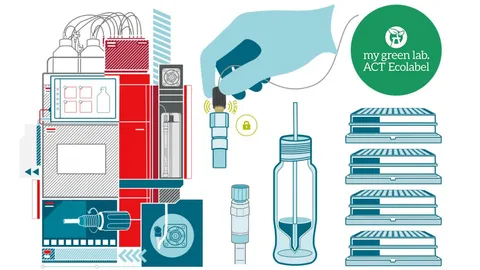
How to Accelerate Your Lab Operations With Modern LC Systems
This case study shows how one pharmaceutical laboratory cut total analysis time from more than 2 hours to 24 minutes by modernizing its methods.View App Note / Case Study
Sustainability as a core design requirement
How important is sustainability in the current era of mass spectrometry and research?
Sustainability emerged as another major theme across the product launches. While environmental considerations were once viewed as desirable extras, Potts explained how sustainability features have rapidly become a fundamental requirement for laboratories that want to reduce their environmental footprint, as well as their day-to-day running costs.
"Everybody has sustainability goals, and we continue to hear that feedback around the costs of running a lab," Potts said. "If you can reduce power and gas consumption, that also helps from a business point of view to reduce costs."
For GC-MS, a significant part of this calculation is the use of helium as a carrier gas. As a non-renewable commodity, most commercial helium is produced as a byproduct of natural gas extraction and processing, making it particularly vulnerable to shifts in the market and supply chain.
"Customers are asking 'how do I shield myself from this as much as possible, without changing over to hydrogen as a carrier gas?' and the way you do that is to make sure you aren't wasting helium when you are doing your work," Potts said.
To address this, the newly-launched 8890B and 8860B GC systems, alongside several other instruments, are fully compatible with Agilent's helium conservation module—an accessory that allows for easy switching to a different carrier gas (typically nitrogen) when the instrument is idle.
Building Scalable, Connected Capillary Electrophoresis Workflows
This webinar examines how laboratories can prepare capillary electrophoresis operations for changing workflow expectations.View Webinar
"At night-time, your GC can still be on, but it shouldn't be flowing helium if it's not doing any work," Potts said. "Now at the push of a button, we can have that set up."
Gas and power consumption are just one element of what makes an instrument a sustainable choice. For those who want to prove the sustainability credentials of a given instrument, My Green Lab's ACT® Ecolabel accounts for a broad range of product-focused and company-focused metrics when considering how to score products on its 100-point weighted scale.
"My Green Lab evaluates in terms of overall sustainability. That includes the manufacturing facility, how the instruments are shipped, how much packaging material is used, how much material is recyclable, and more. It's incredible everything that they measure to deem what is sustainable," Tichy explained.
Agilent's InfinityLab Pro iQ Plus Mass Detector has now received a platinum ACT Ecolabel certification, indicating a score of over 70 points.
Next-Generation Analysis for Bioanalysis and Nitrosamines
Explore practical LC-MS/MS workflows for nitrosamine and NDSRI monitoring, impurity confirmation, and quantitative bioanalysis. Learn strategies for trace-level quantitation, compound identification, workflow efficiency, and compliance readiness.View Webinar
"This is the first time that any mass spectrometer has made it into the platinum stage [of the ACT Ecolabel tiers], and a lot of that is because we look at every one of those parameters and incorporate it into the system in order to achieve the highest amount of sustainability," Tichy said.
What drives sustainable instrument development?
- Reduced power consumption lowers laboratory operating costs.
- Helium conservation addresses supply-chain and cost concerns.
- Company-wide practices matter just as much as instrument properties.
- Sustainability metrics increasingly influence laboratory procurement decisions.
Beyond 2026: Automation and the "dark lab"
Where are the greatest opportunities for innovation in mass spectrometry?
Looking ahead to the future, the Agilent team sees significant interest and opportunities in the use of automation, as labs look to free up scientists from the day-to-day running of apparatus to instead apply them to the more valuable tasks that require strong analytical thinking.
"We had a customer around a month ago say that they wanted a dark QA/QC lab and they wanted us to help them get there. At the moment, people are running all of these instruments with some level of automation, but we're just scratching the surface," Winkett said. "It’s about more than an autosampler or an autodilutor. It's about hardware, software, and taking humans out of the process completely."
The dark lab
A "dark lab" is a fully automated scientific testing facility where the apparatus are operated entirely by machines and AI systems. The name comes from the fact that, without humans who need light to see, these facilities can be operated in total darkness—which also helps save on energy costs.


Bring Multi-Technique Analytical Data Into One Workflow
This app note illustrates processing, assignment, and reporting with examples from nuclear magnetic resonance, chromatography, mass spectrometry, and infrared spectroscopy.View App Note / Case Study
"To me, that is the next revelation in not just mass spectrometry, but across most analytical equipment," Winkett concluded.
Potts added, "To build on that, it really does all depend on the customer. Not all customers are going to want a dark lab, but they do want better automation, and I think that understanding these different use cases and fitting those needs is going to be really important."
Beyond automation, advances in data analysis and predictive modeling could also significantly accelerate the field.
"[Automation] is in the lab, but at the data analysis level, there are also going to be big changes," Mangelschots said.
"We may be going from wet–dry–wet experiments to a dry–dark–dry setup, and this is going to revolutionize and also accelerate [analysis]. In the meantime, advances in data analysis, predictive chromatography, and other simulation techniques will make it much quicker to get to the eventual formulation that you are wanting to achieve."
Promising future innovations:
- Expansion of automation enables dark lab setups.
- Predictive chromatography can predict retention times and optimize analysis.
- Improved accessibility without sacrificing performance.
Through improved ease-of-use and simple maintenance, the traditional barriers to implementing mass spectrometry in the laboratory are gradually being overcome. At the same time, instrument designers are keenly aware of the need to balance high-performance with better sustainability metrics. Through further developments in automation, data analysis, and predictive modeling, there are many different avenues through which mass spectrometry will continue to accelerate analytical science.
- Alongside analytical performance, accessibility is becoming key for instrument adoption.
- Sustainability considerations now influence every stage of instrument development and purchasing decisions.
- AI, automation, and predictive analytics integration are expected to drive the next wave of mass spectrometry innovation.
 Add Technology Networks as a preferred Google source to see more of our trusted coverage.



