We've updated our Privacy Policy to make it clearer how we use your personal data. We use cookies to provide you with a better experience. You can read our Cookie Policy here.
Georgina Davies holds a First-Class BSc in Animal Behaviour and a Master of Philosophy (MPhil) in Anthrozoology from Liverpool John Moores University, along with a Certificate of Higher Education in Neuroscience from Cardiff University. Her academic journey has been driven by a fascination with biological systems and a rigorous approach to research, earning her recognition as the top-performing student in her cohort.
Our immune system eliminates abnormal cells every day, yet cancer can find ways to avoid immune detection and suppress the anti-tumor response. This interplay between tumor cells and the immune system is at the heart of cancer immunology.
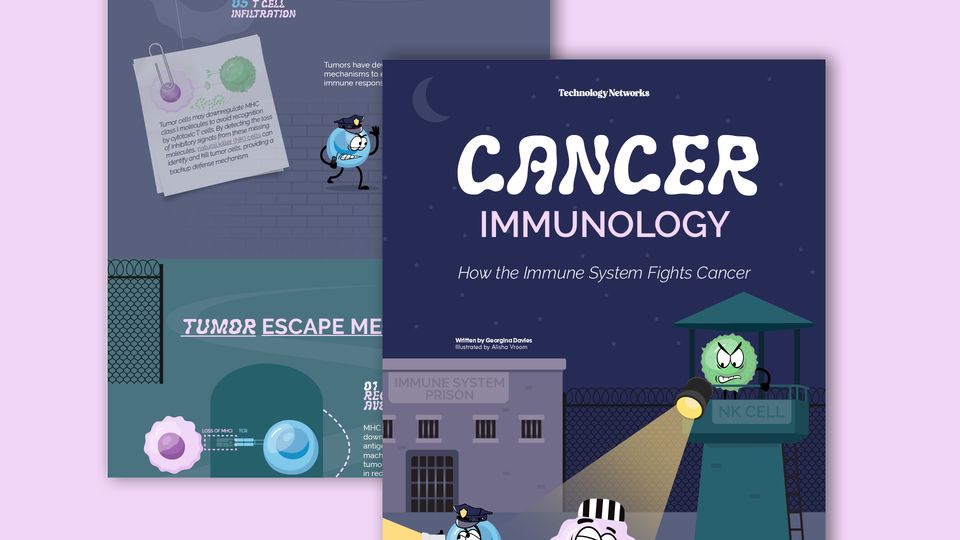
This infographic explores the dynamic relationship between cancer and the immune system, from immune recognition and activation to tumor escape and therapeutic intervention.
Download the infographic to explore:
The stages of the cancer immunity cycle
Key mechanisms of tumor immune evasion
Approaches driving the future of immunotherapy
Written by Georgina Davies
Illustrated by Alisha Vroom
Traditionally, cancer treatments have targeted tumors from the outside, but
modern medicine is increasingly harnessing the body’s internal defenses to target cancer
from within. Although our immune system eliminates abnormal cells every day, cancer
can develop strategies to evade immune detection and destruction. By understanding
how immune cells recognize, target, and sometimes fail to eliminate tumor cells,
scientists are developing therapies that harness these pathways. This infographic
explores the world of cancer immunology, revealing how the immune system fights
cancer and highlighting the breakthroughs driving the future of immunotherapy.
THE CANCER
IMMUNITY CYCLE
At the heart of cancer immunology is anti-tumor immunity—the process
by which the immune system recognizes and eliminates cancer cells.
This is not a single event, but a repeating cycle of immune recognition,
T-cell activation, and tumor cell killing.
How the Immune System Fights Cancer
CANCER
IMMUNOLOGY
Antigens from dying tumor cells are
taken up by antigen-presenting cells
(APCs), including dendritic cells (DCs)
and macrophages.
01 Release
of antigens
04 T cells
travel
to tumor
05 T cell
infiltration
04 T cellS
TRAVEL
TO TUMOR
T cells release cytotoxins to
kill the cancer cell.
07 Cancer
cell death
DCs present antigens to
CD8 + cytotoxic T cells via
MHC class I molecules.
02 Antigen
presentation
The T-cell receptor (TCR)
recognizes a specific antigen.
T-cell activation also requires
adequate costimulatory
signals from the APCs.
03 T-cell
activation
T cells detect tumor-specific antigens
(TSAs) or tumor-associated antigens (TAAs),
which are presented on the tumor
cell surface via MHC class 1 molecules.
06 T cells recognize
cancer cells
Tumor cells may downregulate MHC
class I molecules to avoid recognition
by cytotoxic T cells. By detecting the loss
of inhibitory signals from these missing
molecules, natural killer (NK) cells can
identify and kill tumor cells, providing a
backup defense mechanism.
MHCI TCR
Tumors have developed multiple
mechanisms to evade this
immune response...
TUMOR ESCAPE MECHANISMS
Myeloid-derived suppressor
cells (MDSCs) and regulatory
T cells (Tregs) inhibit the
anti-tumor response.
03
Regulatory immune
cell recruitment
MHC class I molecule
downregulation, defective
antigen processing
machinery, or a lack of
tumor peptides each result
in reduced visibility to
cytotoxic T cells.
01
Recognition
avoidance
Cytokines and metabolites
suppress the immune response.
Tumor-associated macrophages
(TAMs) and DCs also suppress
the immune response, and
TAMs facilitate angiogenesis.
02
Immunosuppressive
microenvironment
Tumor cells exploit immune
checkpoint pathways, including
PD-1/PD-L1 and CTLA-4, to
suppress T-cell activity and
evade immune attack.
04
Using
checkpoint
molecules
MHCI
CD80/86 CD28
TCR
LOSS OF MHCI TCR
MHCI
PD-L1
TCR
PD-L1
IMMUNOTHERAPY
Insights into tumor immune evasion have driven the
development of immunotherapies that enhance or
restore the immune system’s ability to fight cancer.
VGEF
TGF-ß, L-10
LACTATE,
AMMONIA
01
02
03
04
05
06
Lab-made proteins
bind to tumor antigens,
triggering the immune
response.
Monoclonal
antibodies
Next-gen antibodies
simultaneously bind
tumor and immune
cells, causing immune
activation.
Bispecific and
multi-specific
antibodies
Monoclonal antibodies
carry drugs and toxins
to the tumor cells.
Drug
conjugates
Nucleic acid, protein, cell,
or vector-based therapeutic
vaccines stimulate the immune
system to destroy cancer cells.
Cancer vaccines
T or NK cells are expanded
and/or genetically engineered
(e.g., with chimeric antigen
receptors) to target cancer.
Adoptive cell
therapy
Prevent T cells from
receiving inhibitory
signals from tumor cells.
Immune
checkpoint
inhibitors
(ICIs)
Infect cancer cells,
killing them and
releasing their antigens.
Oncolytic
virus therapy
Enables precise delivery of
ICIs or cancer vaccines,
minimizing systemic toxicity.
Nanotechnology
-driven
immunotherapies
TARGET
Tumor antigen
ACTION
Antibody binds to
the tumor antigen
RESULT
Triggers the immune
response against
tumor cells
TARGET
Tumor antigen and
immune cell antigen
ACTION
Brings immune cells
and tumor cells into
close proximity
RESULT
Activate immune
cells to attack and
eliminate tumor cells
TARGET
Tumor-specific antigens
ACTION
Antibodies deliver
drugs or toxins to
tumor cells
RESULT
Kills cancer cells while
limiting damage to
healthy cells
TARGET
Tumor-specific
antigens
ACTION
Stimulate the immune
system to attack
cancer cells
RESULT
Activates immune cells
to recognize and
destroy cancer cells
TARGET
Tumor-specific
antigens
ACTION
Engineered T or NK
cells target cancer cells
RESULT
Immune cells recognize
and destroy targeted
cancer cells
TARGET
Immune checkpoints
ACTION
Block inhibitory signals
that suppress T cells
RESULT
Restores T-cell activity
against cancer cells
TARGET
Cancer cells
ACTION
Viruses infect and
destroy cancer cells
RESULT
Releases tumor antigens
and activates an
immune response
TARGET
Tumor cells and
immune targets
ACTION
Precisely delivers ICIs
or cancer vaccines
RESULT
Enhances treatment
while reducing
systemic toxicity
CONCLUSION
The immune system’s fight against cancer is a cycle of recognition, attack, and
adaptation. Immunotherapy helps tip the balance in favor of the body’s natural
defenses, transforming cancer from an evasive threat into a visible, targetable opponent.
MHCI
PD-L1
TCR
PD-L1
This is typically done ex vivo using patient or donor cells, with emerging
approaches enabling in vivo engineering
Sponsored by:
Antigens can be presented to
CD4+ helper T cells via MHC class II
molecules, activating them into Th1
cells, which support the
immune response.
TARGETED ANTIBODIES
Download the Infographic for FREE Now!
Information you provide will be shared with the sponsors for this content. Technology Networks or its sponsors may contact you to offer you content or products based on your interest in this topic. You may opt-out at any time.