
Calcium-Sensitive Switch Enhances Cancer Drug Delivery
Delivery system exploits calcium differences to guide cancer drugs deeper into tumors, while sparing healthy cells.
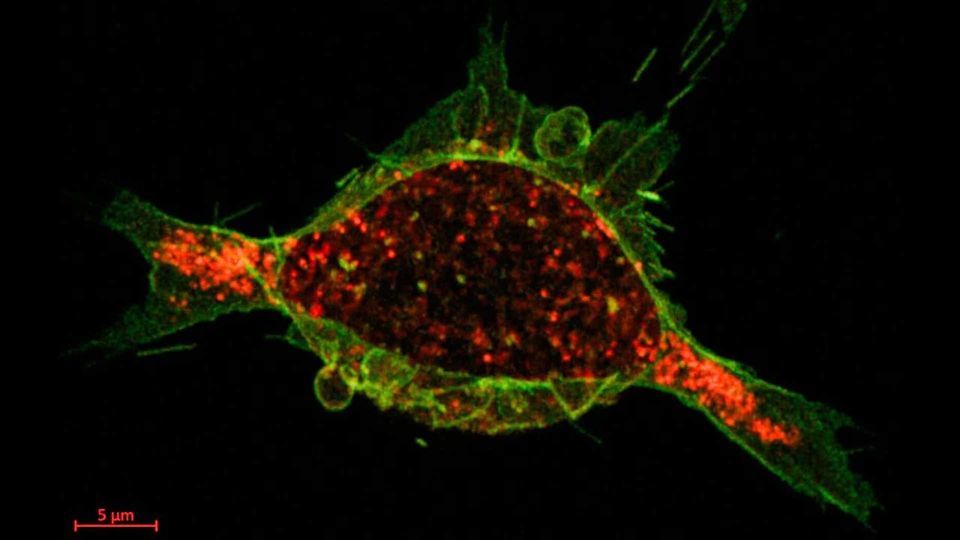
Cancer-fighting antibody drugs are designed to penetrate tumor cells and release a lethal payload deep within, but too often they don’t make it that far. A new study shows how this Trojan Horse strategy works better by exploiting calcium differences outside and inside cells.
A research team led by Sophia Hober, professor at KTH Royal Institute of Technology, reported the development of a calcium activated delivery system they say could enable more precise treatment, with lower doses and less collateral damage to healthy tissue. In collaboration with Stanford University and Umeå University, the researchers reported their results in PNAS, the journal of the National Academy of Sciences.
The concept takes aim at a common challenge with targeted drugs, which tend to cling too tightly to receptors expressed by tumors. On the positive side, that strong bond blocks receptors’ tumor growth signals. But ADCs (Antibody–Drug Conjugates) are also meant to attack and kill, and too often the protein can become stuck without ever penetrating deeper into the cell’s real intended goal: an acidic compartment called the lysosome. There, in the kill zone, the targeting protein can be broken down, thus unleashing toxin that causes cell death.
To avoid that problem, the researchers developed a calcium-sensitive switch that binds strongly to the cancer cell receptor on the outside of the cell where relatively high calcium concentrations are found, in the blood and the extracellular fluid.
Once bound together, the drug-loaded protein (or calcium-regulated affinity, CaRA) and epidermal growth factor receptor (EGFR) are pulled inside the cell, into compartments with gradually lower levels of calcium. And because their bond is calcium dependent, the receptor and CaRA eventually go their separate ways: the receptor can recycle back to the membrane, while CaRA continues carrying its payload toward the lysosome.
“The calcium switch is built into the drug design,” Hober says. “It senses calcium levels and changes its grip automatically.”
Co-authors Malin Jönsson and Marit Möller, both postdoctoral researchers at KTH, say the study was performed on living human cancer cell lines, using a payload of the cytotoxin, mertansine DM1. In the tests, the concentration of the CaRA EGFR–DM1 conjugate needed to kill 50 percent of high EGFR-expressing cancer cells was extremely low, which Jönsson says indicates very high potency. It had no effect on low EGFR-expressing cells:
“The drug conjugate is highly selective—it only kills cells that overexpress EGFR, leaving healthy or low-EGFR cells unharmed,” Jönsson says. “This shows specific targeting and a strong therapeutic window, which is critical for reducing side effects.”
Reference: Jönsson, M., et al: Engineered calcium-regulated affinity protein for efficient internalization and lysosomal toxin delivery. PNAS. 2025 doi: 10.1073/pnas.2509081122
This article has been republished from the following materials. Note: material may have been edited for length and content. For further information, please contact the cited source. Our press release publishing policy can be accessed here.
 Add Technology Networks as a preferred Google source to see more of our trusted coverage.

