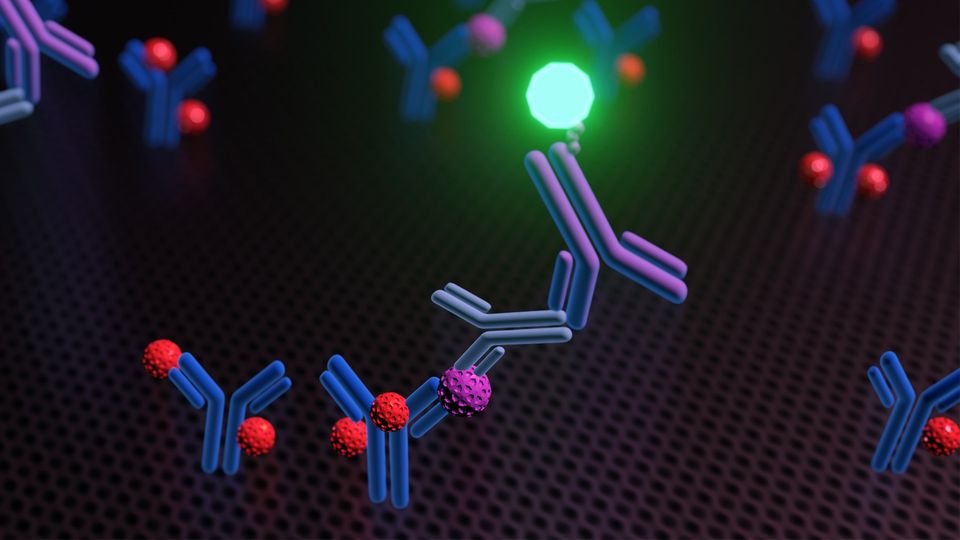
Immunoassay development is advancing rapidly, but strong analytical performance alone is not enough to ensure commercial success.
In order to succeed, developers must balance clinical utility, regulatory requirements, manufacturing scalability, workflow integration, and post-launch lifecycle management.
This listicle explores six critical factors that can help transform promising immunoassay technologies into products that meet the needs of laboratories, clinicians, and healthcare systems.
Download this listicle to learn:
- Why intended use should guide development from the start
- How regulatory and manufacturing considerations influence commercialization
- The role of user experience and post-market insights in supporting adoption
1
Six Factors Shaping Successful
Immunoassay Commercialization
Successful commercialization requires balancing scientific innovation
with real-world implementation
Michelle Dotzert, PhD
Immunoassays are essential in clinical diagnostics, drug development, life sciences research, and precision
medicine, as they enable the detection and quantification of proteins, antibodies, hormones, and
other biomarkers. Advances in assay technologies are expanding where they can be implemented; digital
immunoassays are lowering detection limits, and multiplex platforms measure multiple targets simultaneously.
Further, companion diagnostics are increasingly connecting biomarker measurements with
therapeutic decisions.
While these advances offer many benefits, they add complexity to the development process. There are
several factors in addition to technical performance that determine whether an immunoassay succeeds.
Developers must consider many factors, and this article highlights six that are shaping the development
of successful commercial immunoassays.
1. Precision medicine is redefining assay value
In medicine, biomarkers are increasingly used as companion diagnostics. They can identify patients most
likely to benefit from a specific therapy, predict or monitor treatment response, or help to distinguish
among disease subtypes, among other applications. Therefore, immunoassays must be able to detect a
target and provide measurements that inform clinical decision-making.
Companion diagnostics demonstrate how biomarker measurements are becoming more closely linked
to treatment decisions. They are sometimes developed in association with therapeutic products and can
be essential for identifying patients for whom treatment is indicated or for whom it may pose increased
risks. For example, immunohistochemistry-based assays that detect HER2 protein expression can help
identify patients with breast cancer who may benefit from HER2-targeted therapies.
The development of companion diagnostics requires a therapeutic strategy, assessment of assay performance,
and clinical evidence supporting the biomarker. As such, it is especially important to define the intended
use and unmet need early in development. Developers must understand what an assay measures,
how the result will be used, by whom, and what decision it is intended to support.
Listicle
SIX FACTORS SHAPING SUCCESSFUL IMMUNOASSAY COMMERCIALIZATION 2
2. Immunoassay performance must translate into clinical value
Sensitivity and specificity are fundamental measures of immunoassay performance, but several factors
determine how reliably an assay performs outside a controlled development environment. These include
precision, dynamic range, interference, sample requirements, reproducibility, and consistency across
operators.
Improvements in these characteristics can have meaningful clinical implications. High-sensitivity cardiac
troponin immunoassays, for example, offer greater analytical sensitivity and improved precision at low
troponin concentrations. These advances enable detection of myocardial injury at lower biomarker concentrations
and support testing that can more rapidly guide patients down appropriate clinical pathways.
However, improved analytical performance can introduce new challenges. In the case of cardiac troponin,
greater sensitivity means that elevated troponin may be detected in conditions other than acute myocardial
infarction. As such, clinical interpretation is critical.
For clinical assays, developers should demonstrate that analytical performance translates into meaningful
insights by establishing clinical validity (the relationship between a biomarker and a condition or outcome)
and utility (evidence that using the test leads to improved patient management or health outcomes).
3. Commercial scalability begins during immunoassay development
Once an assay performs well in a development laboratory, it then needs to be manufactured consistently,
and potentially on a substantial scale. If manufacturing is an afterthought, existing development processes
may be difficult or expensive to reproduce commercially. As such, raw material selection, manufacturing
processes, quality control, and storage conditions should be considered early.
The COVID-19 pandemic is an example of the importance of planning for both manufacturing scale and
supply chain resilience. A surge in demand for diagnostic testing created shortages of reagents, swabs,
and other essential materials. Manufacturers faced constraints in sourcing these components and expanding
production capacity. This scenario demonstrates the importance of identifying critical materials,
qualifying suppliers, and considering alternative sources before demand increases.
When designing for scale, developers should also consider whether materials and methods are optimal
for reproducible, cost-effective production.
4. Regulatory strategy should shape assay development
from the start
Regulatory requirements can shape many aspects of assay commercialization, from study design and
performance claims to documentation and post-market responsibilities.
In the United States, in vitro diagnostic products are regulated by the US Food and Drug Administration,
with regulatory requirements and premarket pathways determined in part by their intended use and
associated risk. There are additional considerations for companion diagnostics as they are developed for
use with corresponding therapeutic products.
Listicle
SIX FACTORS SHAPING SUCCESSFUL IMMUNOASSAY COMMERCIALIZATION 3
Requirements also vary by market; in Europe, for example, the In Vitro Diagnostic Regulation (IVDR) introduced
a risk-based classification system and requirements covering clinical evidence, conformity assessment,
and post-market surveillance.
If these requirements are considered after an assay is technically complete, developers risk delays as additional
studies may be required. Integrating regulatory strategy throughout development can help align
assay design, validation, quality systems, and documentation with the intended regulatory pathway. It may
be beneficial to engage early with regulatory specialists and authorities who can clarify requirements
before developers commit resources to testing and validation.
5. Immunoassay user experience is a competitive advantage
A well-validated assay may still face barriers to adoption if it is difficult to incorporate into existing laboratory
operations. Developers must consider several factors in this regard: sample preparation, hands-on
time, throughput, instrument requirements, staff training, data management, quality control, and compatibility
with existing workflows to support adoption.
Automation and software connectivity can help address some of these considerations. Integrating assay
platforms with laboratory information systems (LIS) can reduce manual data entry and facilitate results
transfer, while automated sample handling and analysis can reduce the physical labor required for more
standardized workflows.
To ensure these capabilities deliver the most value, it is important to consider the setting in which the assay
will be performed. Centralized laboratories, for example, may prioritize throughput, automation, and
integration with existing systems, while point-of-care settings may value rapid turnaround, portability,
ease of use, and the ability for workers to run the assay without formal laboratory training.
When developers understand these differences early in the process, they can design assays around the
needs of the intended users. It may be valuable to seek input from laboratory professionals and end users
to identify practical barriers that may be overlooked.
6. Commercialization continues after assay product launch
The commercialization process does not end with the immunoassay launch. When the product is in
routine use, developers can obtain performance information across different laboratories, patient populations,
operators, and workflows. For regulated diagnostic products, post-market surveillance serves as
a formal approach for collecting and evaluating information about product performance and safety after
launch. User feedback can provide additional insights into ease-of-use, workflow challenges, training
requirements, and opportunities for improvement.
These insights can be used to inform ongoing product development and lifecycle management. Depending
on the assay and corresponding regulatory pathway, these changes may include improving workflows
and automation, adapting the assay for different testing environments, or expanding its intended use.
Listicle
SIX FACTORS SHAPING SUCCESSFUL IMMUNOASSAY COMMERCIALIZATION 4
Immunoassay Commercialization: Looking ahead
Immunoassay technology will continue to evolve, but technical developments are only one aspect of
successful commercialization. For an immunoassay to be widely implemented, developers must connect
analytical performance and clinical need. They must also meet regulatory requirements, ensure manufacturing
scalability, and consider laboratory workflows and lifecycle management.
Commercialization planning should occur in tandem with assay development, as early decisions around
intended use, reagent selection, and validation strategy can influence later regulatory and manufacturing
requirements and the path to market. This integrated approach can help developers translate promising
immunoassay technologies into products that meet the practical needs of laboratories, clinicians, and
health systems.
Sponsored by
About the author:
Michelle Dotzert, PhD, obtained her PhD in Kinesiology specializing in exercise biochemistry at the University of Western Ontario.
Listicle