
Has Mass Spectrometry Reached a Software “Tipping Point”?
After decades of hardware advancement, is software the next frontier for advancing mass spectrometry?
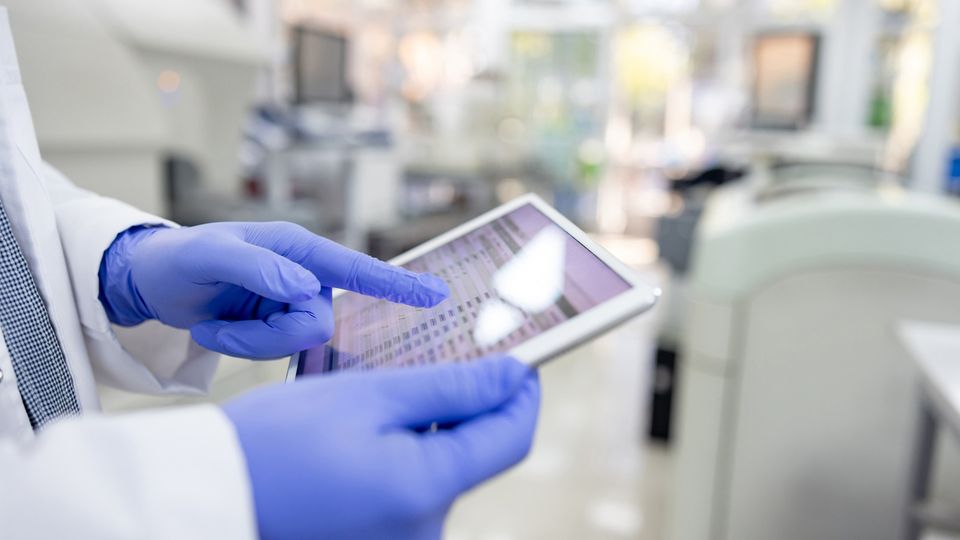
For decades, the idea of advancement in mass spectrometry was usually synonymous with breakthroughs in hardware. New designs for ionizers, mass analyzers, and the introduction of novel hybrid architectures have allowed the field of mass spectrometry to get faster, be more sensitive, and improve resolving power.
Today, hardware advancements are still important—there is significant demand for more sustainable instruments that consume less power and carrier gas, while still maintaining their analytical power. But there is also an increasing recognition of the role that software can play in supporting mass spectrometry efforts.
Modern high-resolution mass spectrometers produce a huge volume of often multi-dimensional data. Through specialized software, scientists can clean up noisy data, perform statistical analyzes and database searches, reconstruct the structures of interesting analytes, and more.
To discover the extent to which software is transforming mass spectrometry experiments, Technology Networks asked a range of attendees at the 74th ASMS Conference on Mass Spectrometry and Allied Topics: “Are we approaching a tipping point where software is now playing an equal—or bigger—role in driving developments in mass spectrometry?”
Ansgar Korf, PhD. Chief executive officer at mzio
“I think that we've been at this tipping point for a long time. Software has had an equal role in driving developments, perhaps not in terms of visibility, but data is almost nothing without software. Imagine if you had very simple software that could only handle simple data points—how could you use that if you needed to analyze 100 or 1000 samples?
“Both software and hardware need to co-exist in a type of symbiosis, and having this balance is very important.”
James Hallam. Vice president and general manager, LC-MS at Waters Corporation
“There is still a lot to be done in terms of hardware development. But as we continue to generate more data, more information, software becomes absolutely critical in being able to interpret these huge and complex datasets.
“In terms of hardware and sensitivity, you can get incredible sensitivity already; some might argue that we are approaching a point of diminishing returns when it comes to getting more sensitivity because these instruments are so sensitive already, and that sensitivity comes at a cost in terms of potential for contamination. But based on what customers are telling us, their greatest need now is more robustness. They need these extremely sensitive instruments to run for longer timeframes without needing to have service intervention. That is why we are designing these new instruments that we have, so that labs who are really just using the mass spec as a tool to generate data and drive their business don’t have to worry about these more technical challenges.
“But on the software side, you do have labs where, if you are running tens, hundreds, or thousands of samples, it might be that you are looking more for anomalies or where you have changes in failure rates, for example. The vast majority of these runs are not going to have anomalies or failures, and so you want to be able to ignore those. Smart software can help here by flagging these things to the user. This is just one example, but it is another key thing that we have recognized and introduced.”
Gary Harland. Senior director, HRMS, Portfolio owner, LC-MS at Waters Corporation
“We have a phrase for when we are building the requirements for the development of a new instrument, and that is ‘all of the -ilities.’ This encompasses the capability of the system, its deployability, accessibility, all of these types of elements. We really have to think about how this instrument is going to be used and the environment that it will be in.
“Software is definitely the fastest thing you can use to drive forward the capability of these systems. But then, the speed of electronics development is also incredible; that enables the same hardware to do more acquisition modes or improve speed, resolution, and other areas.” — Gary Harland.
“I believe there is a long runway to go in terms of thinking about developments on the hardware side, but this theme of thinking about the ‘-ilities’ from a holistic view—with hardware and software—is really guiding how we are thinking about development.”
Melissa Sherman, PhD. Chief executive officer at MOBILion Systems
“I think we have reached that tipping point; I think we are there. But I think it has been slightly ignored, and that is part of why data processing can be so difficult and so laborious. Nowadays, some mass spec core leaders will say that they don't need an instrument with higher throughput because it just creates downstream problems when trying to use software programs to analyze that data. So I think we are already there, but perhaps traditional mass spec companies are just realizing that.”
Frederick Strathmann, PhD. Senior vice president of global business at MOBILion Systems
“As AI models and more advanced software get applied, what you do start realizing is that, in the past, all of this compute power was built around the need to make sense of really complex data. And that is because of a lack of specificity with the way that these assays had to be done.
“What I think we will see—and what I think will be really exciting—is that we are going to see a proliferation of new AI tools. We are already starting to hear use cases for these out of pharma and biopharma. Maybe they are not quite getting what they expected out of it just yet, but often that comes with the understanding that maybe the data that they had originally, wasn't as high quality as they thought it was; we have had decades of innovation on hardware, but now these AI models and data analytics tools have uncovered where the problems really lie.
“I think that the next generation of this is not necessarily going to be about going faster, but it will be a case of seeing how to make data fundamentally better so that these models can really make a difference.”
Matthew Lewis, PhD. Vice president, metabolomics and lipidomics at Bruker Daltonics
“This is the age of AI, so data has become even more important. The more high-quality data that is available, the greater the potential that something interesting can be derived from it. From our point of view with 4D-metabolomics datasets, that means a whole extra dimension of data that we can use with these AI models. Hardware is very important, of course, but I firmly see the importance of a focus on data, the value of data, and indeed the software needed to process that data.
“In the past, software was largely deterministic. In the future, it may become much more dependent on AI—that is the evolution.” — Matthew Lewis, PhD.
“The truest answer I can give you is that it must be a balance; you have to balance your capability to generate data with your ability to interpret it, understand it, and act on it.”
 Add Technology Networks as a preferred Google source to see more of our trusted coverage.



