
Precision Immunotherapy: Beyond the Monoclonal Antibody
Researchers are engineering smarter antibodies to improve cancer targeting, efficacy, and safety.
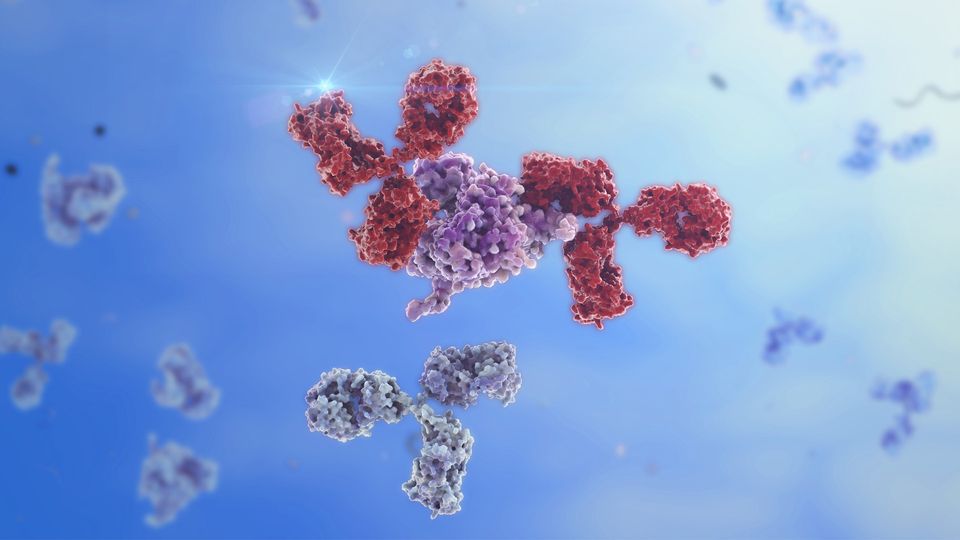
In 1907, pioneering oncologist and future Nobel Laureate Paul Ehrlich envisioned a future where “magic bullets” would be developed to precisely target disease without harm to the patient. Now, over a century and several Nobel Prizes later, modern immunotherapies are poised to fulfill his prophecy.
For many, immunotherapy can be a terrifying roller coaster ride. Potent antibody-based biologics attack tumor targets and some healthy tissue alike, resulting in debilitating side effects for cancer patients. For some people, the trade-offs are worth it: tumors shrink, markers of health improve, and the cancer appears to be in remission. But tumors learn from these initial assaults and adapt to survive. Months later, the patient relapses as a new drug-resistant tumor emerges, and the ride begins again.
Today, a new generation of immunotherapies is being developed with greater specificity, crippling the cancer's immune evasion tactics, and directly engaging the immune system. At the heart of it all is one molecule that is already inside of us—the antibody.
Monoclonal antibodies
Antibodies, including monoclonals, are Y-shaped proteins that recognize and flag foreign objects for removal from the body. "Antibodies are really amazing molecules in our body because they already are multifunctional," said Dr. Jamie Spangler, associate professor of the Biomedical and Chemical & Biomolecular Engineering departments at Johns Hopkins University.
In the case of monoclonals, both arms of the Y bind to the target protein, whilst the base—the Fc region—can call in an immune system airstrike on the tumor’s position.
The precise specificity of the monoclonal for its target is also its key limitation. Target proteins that are highly expressed on tumors may also be present at lower levels in healthy tissues. The monoclonal cannot distinguish between the two niches, resulting in off-tumor attack and side effects. Meanwhile, on-target efficacy decreases.
Protein engineers have made significant advances in optimizing monoclonals’ architecture for greater tumor specificity and therapeutic efficacy. They have added extra functionality into the outer arms and programmed environmental sensing into the core domain using several innovative approaches.
Antibody tissue penetration: less is more
In the 1500s, the founding father of toxicology, Paracelsus, famously observed: “All things are poison … only the dose makes something not.” Could weakening a monoclonal’s affinity for its target preserve its potency while improving its safety?
Indeed, oncologists have observed that aggressively targeting tumors with maximum doses of immunotherapy results in effective cell death on the outer layer of the tumor, but poor penetration into the core. Dr. Greg Thurber, a professor of chemical and biomedical engineering at the University of Michigan, adopted the Paracelsus approach to address this problem. Thurber has shown that reengineering antibodies to bind less efficiently to tumors can improve drug efficacy.
How does that work? Thurber explained: “Reducing antibody affinity allows molecules to disengage from cells near the [tumor] wall and diffuse deeper into the tissue.” This means they are no longer trapped in the perimeter. The result: better tumor penetration and greater clinical efficacy at lower therapeutic doses.
Monoclonals are being tweaked to reduce unwanted side effects caused by off-tumor binding.
Adding functionality with bispecific antibodies
Bispecific antibodies are engineered to have different target recognition sites on each arm of the “Y.” They can recognize two different targets, effectively doubling functionality.
The extra binding site allows bispecifics to target combinations of tumor proteins. Adding a second tumor-recognition site can promote binding to cancer cells with both targets, rather than healthy tissue that may only have one. Spangler explained: "When you introduce bispecific antibodies, you have a whole new realm of possibilities for mechanisms that they can act through." The result is greater on-tumor clustering and a more focused immune response.
Another option: aim the second arm not at the tumor but directly at circulating T cells, the scouts of the immune system. Spangler noted: “Just one binding interaction is enough to recruit the effector [cells, by tethering] the tumor to the T cell." She added that this creates a “clustering effect.”
Unfortunately, these promising T-cell engager strategies have introduced a new complication—an over-stimulated immune system which can trigger the potentially fatal release of inflammatory cytokines. Developing safer therapies will need a more nuanced “Goldilocks” response to T-cell engagement, one that recruits sufficient immune activity for tumor death but not enough to endanger the patient.
To do this, the next generation of antibodies will need another arm … or two.
Trispecific antibodies, and beyond
Spangler’s laboratory develops a specific subset of multispecific antibodies known as multiparatopic antibodies. This class targets multiple sites, called epitopes, on a single target protein. Evaluating these drugs is still confined to the laboratory, but she noted that early results appear promising: "If you have two different paratopes [antibody arms], you get a good amount of downregulation [of the receptors on cancer cells].”
“But if you have three different paratopes, you get significantly more downregulation than with two," she added.
Whilst the molecular arrangement of trispecific antibodies on tumor surfaces is not known, Spangler noted the advantage of using three binding sites: “You can actually achieve these whole surface networks, and you get a lot more cross-linking and more efficient clustering compared to what you would get with just a bispecific antibody."
The goal is to combine the most promising strategies of bispecific antibodies into a single drug with three or even four functions. Relapse is still possible with bispecific therapies, but the addition of another tumor-binding site along with a T-cell engager might be enough to overwhelm the cancer. The key is to find complementary target proteins in the tumor microenvironment that might fit the bill.
One promising new route for targeting the third binding site is checkpoint inhibition, which blocks mechanisms by which tumors shield themselves from immune detection. Checkpoint proteins on the tumor surface prevent T-cell activation, which would otherwise eliminate the tumor. Blocking these evasion pathways could restore the tumor’s vulnerability to immune attack.
With several tumor-associated target proteins and T-cell engagers to choose from, research is focused on the most effective combinations of binding sites to maximize tumor killing while minimizing toxicity. Expectations are high that multiple tumor-killing combinations can improve the potency of these therapies, but this approach may not resolve off-tumor binding entirely.
How Antibodies Reach Commercial Scale for Diagnostic Tests
This whitepaper follows an antibody's path to full production and shows where a contract partner can take on one step or the whole process.View Whitepaper
To address this, logic-gated antibodies are in development.
Adding an “OFF” switch to antibodies
Logic-gated antibodies are intentionally inert drugs that are activated only upon entry to the tumor microenvironment. To achieve this, researchers exploit fundamental differences between the tumor microenvironment and healthy tissue. A number of strategies, applicable to antibodies of any complexity, are under development.
pH
Healthy tissue functions at a near-neutral pH, whilst cancer metabolism creates a slightly acidic environment within the tumor. Dr. Jennifer Maynard's group at the University of Texas at Austin has taken advantage of this discrepancy to engineer pH-gated antibodies. Maynard systematically replaced amino acids in the Fc region to shift optimal antibody functioning into an acidic environment. The result was a nearly 20-fold lower T-cell engagement in healthy tissue than in tumor cells. Animal studies will be needed to test the safety profile.
Target density
Avidity gates, used in tissue-penetration studies, can be deployed to weaken antibody binding to either the tumor or the T cell. By adding extra “weakened” binding sites to the antibody arm, researchers can bias the binding of the antibody to high-density tumor regions while avoiding lower-density targets on healthy tissue.
Thurber described it as a ”Velcro effect.” He noted: "[The antibody] won't engage with immune cells [in healthy tissue] because the affinity is too low. But once it reaches the tumor microenvironment where you have the target of the other arm, it'll be better able to cross-link.”
The same strategy can be used to tweak immune signaling. He added: "In the T-cell engager community, reducing the affinity of the T-cell engager can give you much better tumor specificity."
Antibody masking
Another difference between tumors and healthy tissue is the enhanced expression of proteases within malignant growths. Antibody masking strategies involve adding protein caps to antibodies using a cleavable linker; this process blocks access to the binding domains and renders the antibody drug inert. Once infused into the body, the dysfunctional antibody circulates without effect. Upon entering the tumor, resident proteases cleave the cap off the dormant antibody, exposing the tumor-binding domains and sealing the tumor's fate.
If successful, these new environment-sensing antibody classes with conditional functionality will herald the end of the blunt-force monoclonal approach. When it comes to targeting strategies, drug developers have several options, and clinical trials will better inform oncologists of the best therapeutic combinations.
The biggest challenge for Thurber is not solely the engineering, but, as he put it: “A better understanding of the tumor microenvironment across different patients and across different indications, so that we know which pathways to hit simultaneously.” Identifying new tumor antigens could translate to better immunotherapies.
Ehrlich was right, but in ways he could not have predicted. In the next few years, his bullet may evolve into an environmentally aware, guided missile, all controlled by binary logic. Magic? Yes, thanks to science.
 Add Technology Networks as a preferred Google source to see more of our trusted coverage.



