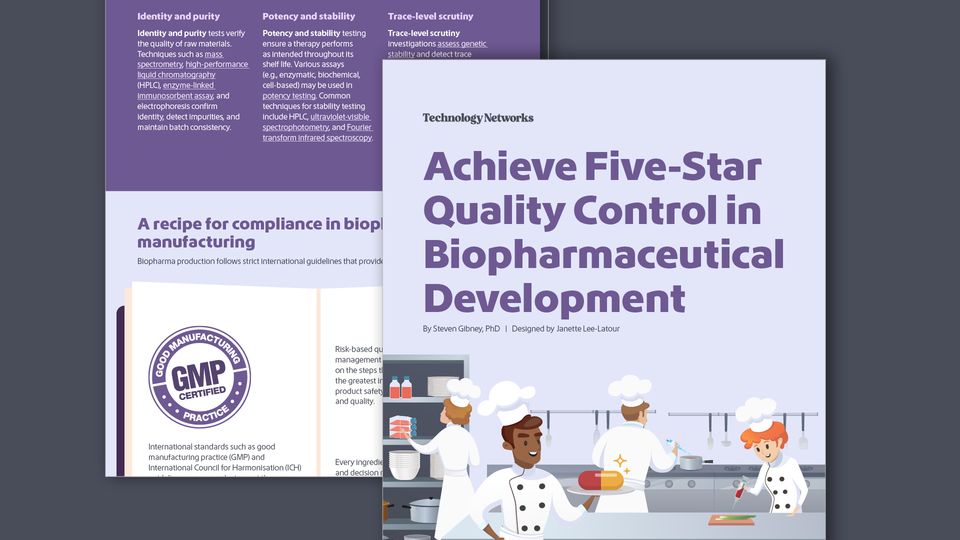
Quality control plays a critical role throughout biopharmaceutical development, helping ensure therapies are safe, effective, and consistently manufactured.
As regulatory expectations evolve, laboratories and manufacturers must balance analytical rigor, trace-level contaminant detection, comprehensive documentation, and operational efficiency.
This infographic explores the analytical techniques, compliance considerations, and emerging technologies shaping modern biopharma quality control workflows.
Download this infographic to discover:
- How identity, purity, potency, and stability testing contribute to reliable product quality
- The importance of detecting trace contaminants and maintaining genetic stability
- How real-time monitoring and continuous manufacturing can strengthen QC processes
During biopharmaceutical development, quality control (QC) ensures that
a therapy not only works but also reaches patients safely. This infographic
explores the analytical methods, regulatory considerations, and cutting-edge
innovations that keep biopharma’s QC running at a five-star standard.
Lorem ipsum
pH TEMP C0�
Achieve Five-Star
Quality Control in
Biopharmaceutical
Development
Using the right tools for biopharma QC
Biopharma relies on a suite of analytical methods to assess a product's characteristics during
manufacturing and before it is distributed.
Identity and purity
Identity and purity tests verify
the quality of raw materials.
Techniques such as mass
spectrometry, high-performance
liquid chromatography
(HPLC), enzyme-linked
immunosorbent assay, and
electrophoresis confirm
identity, detect impurities, and
maintain batch consistency.
Potency and stability
Potency and stability testing
ensure a therapy performs
as intended throughout its
shelf life. Various assays
(e.g., enzymatic, biochemical,
cell‑based) may be used in
potency testing. Common
techniques for stability testing
include HPLC, ultraviolet-visible
spectrophotometry, and Fourier
transform infrared spectroscopy.
Trace-level scrutiny
Trace-level scrutiny
investigations assess genetic
stability and detect trace
contaminants, ensuring cell
banks and raw materials
meet the highest standards
before manufacturing begins.
Depending on the attribute of
interest, approaches include
polymerase chain reaction,
short tandem repeat analysis,
and inductively coupled
plasma mass spectrometry.
A recipe for compliance in biopharmaceutical
manufacturing
Biopharma production follows strict international guidelines that provide the recipe for consistent quality.
Risk-based quality
management focuses
on the steps that have
the greatest impact on
product safety, efficacy,
and quality.
Every ingredient, process,
and decision must be
carefully documented
and traceable, creating a
complete record
of accountability.
Cooking up the future with real-time QC
The latest QC tools enable manufacturers to continuously monitor quality and adapt as needed.
Process Analytical Technology
(PAT) monitors critical process
parameters, such as pH,
temperature, and chemical
composition, allowing
manufacturers to detect and
address minor changes before
they become problems.
Continuous manufacturing
integrates production and
quality monitoring into a
seamless process, improving
efficiency while maintaining
consistent quality.
Artificial intelligence and
machine learning are beginning
to support QC by identifying
patterns, predicting process
deviations, and helping
manufacturers make betterinformed
decisions sooner.
International standards such as good
manufacturing practice (GMP) and
International Council for Harmonisation (ICH)
guidelines ensure products meet the same
high-quality expectations wherever they are
developed or manufactured.
By Steven Gibney, PhD | Designed by Janette Lee-Latour
Five-star quality control relies on a
suite of tools and techniques that
work throughout the manufacturing
process to help deliver safe, effective
therapies with confidence.
Sponsored by: Bio-Rad