
Scientists Solve Mystery of How Cells Tame One of Biology’s Deadliest Metals
An overlooked molecule protects cells from the potentially catastrophic effects of iron overload.
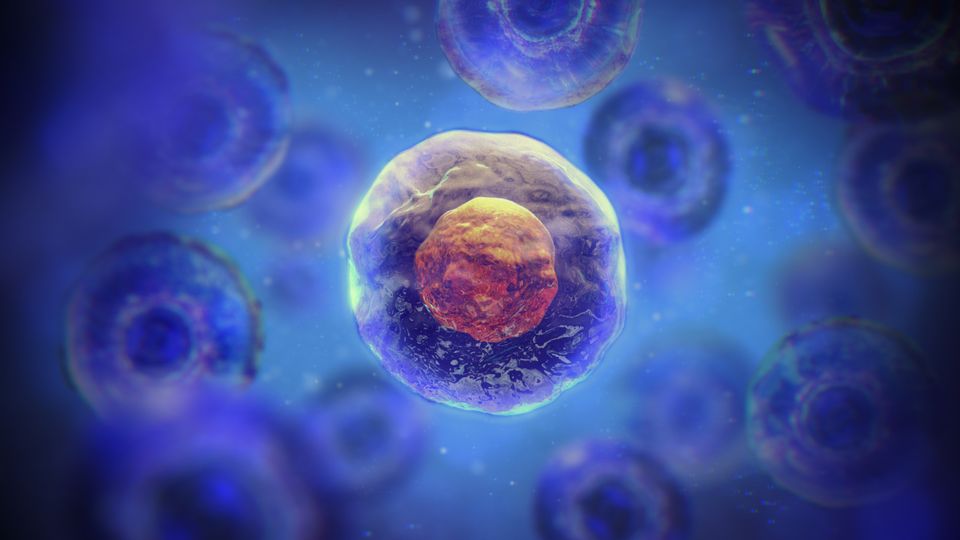
Iron is essential to cell health; it's needed to produce energy, carry oxygen around the body, and catalyze several essential chemical reactions. But this metal can be a double-edged sword. Too much iron in the cells can trigger destructive reactions that shred DNA, wreck proteins, and tear apart cell membranes.
To help cells walk this tightrope, researchers have discovered that they use unassuming molecules for protection: polyamines. These molecules hold iron in a non-reactive state until needed, protecting cells from toxic iron overload.
The new study, published in the journal Cell, helps explain why cells maintain polyamines at high levels—a mystery that has until now eluded scientists. The work provides a possible explanation for the unusually high iron levels observed in the brains of Parkinson’s patients. It could also help inform the development of new cancer therapies that exploit cells' reliance on polyamines.
An overlooked cell savior
Polyamines are essential metabolites present in mammalian cells. Despite their abundance, their functions within cells are incompletely understood.
PhD student Pushkal Sharma and his colleagues at Massachusetts Institute of Technology (MIT) first became interested in polyamines because of their ability to physically bind RNA. “Originally, we were just looking at them as ‘structural helpers’. But then we did the math: these things are sitting inside cells at levels comparable to ATP, the molecule cells burn for energy,” said Sharma.
Sharma and colleagues hypothesized that the sheer abundance of polyamines in cells is too high for a molecule with only a structural role. “It was too big a coincidence to ignore; we figured polyamines had to be doing something else, something bigger, and that hunch is basically what launched this whole project,” explained Sharma.
To uncover polyamines’ hidden function inside cells, the researchers performed a genome-wide CRISPR-Cas9 screen. “Instead of picking one gene at a time and testing it in isolation, which would've taken forever, we used a genome-wide screen that lets us interrogate essentially every gene in the cell simultaneously,” Sharma said.
This allowed the researchers to identify the cellular processes that are affected when polyamine levels are altered. Most notably, the screen showed that reducing polyamine levels causes cells to lean on a protein called GPX4 for survival.
GPX4
GPX4 is an antioxidant enzyme that reduces certain lipid peroxides to alcohols. It is a central regulator of ferroptosis: an iron-dependent cell death pathway driven by the buildup of toxic lipid peroxides in cell membranes.
Polyamine depletion also led to a dramatic increase in ferritin levels, a storage protein that keeps iron in its mineralized form. Together, these results suggest that polyamines play a key role in regulating iron homeostasis, possibly through mechanisms that keep it in a non-reactive state.
This partnership may trace its roots back to ancient times: “…as early life forms evolved to exploit iron’s catalytic power, polyamines could have been co-opted to stabilize redox-active iron and suppress its toxicity,” explained the researchers.
To directly visualize the iron buffering in living cells, the team developed a new sensor. The sensor causes living cells to fluoresce based on the amount of chemically reactive iron they contain, allowing researchers to track changes in real time under a microscope.
By combining this new sensor with an existing sensor that measures polyamine levels in cells, the researchers confirmed that as polyamine levels dropped within cells, the amount of chemically reactive iron increased.
A link between iron and Parkinson’s disease
Loss-of-function mutations in ATP13A2, a polyamine transporter, have been linked to a rare form of early-onset Parkinson’s disease. In addition, several studies have observed increased iron concentrations in the brains of patients with Parkinson’s disease.
These latest findings, which suggest a role for polyamines in iron regulation, point to a possible explanation for the link between Parkinson’s and iron. However, further research is needed to determine exactly how iron levels influence Parkinson’s disease progression.
The sensor developed by the researchers could provide a new tool for investigating this link. “It lets researchers actually track chemically reactive iron inside living cells in real time, which is something that's been hard to do well,” stated Sharma. “Iron dysregulation shows up everywhere—aging, cancer, neurodegenerative disease—so having a reliable way to watch it happen live could power discoveries way beyond our own lab.”
One-Step Cleanup for Single-Cell RNA Sequencing of Human Tumor Tissue
This app note measures cell and sequencing quality in fresh ovarian tumor samples. It then tests cryopreserved samples, where the magnetic protocol saved 25 min.View App Note / Case Study
The sensor’s single-cell resolution supports high-throughput screening for regulators of iron homeostasis and pharmacokinetic studies of iron-targeting therapies, potentially in live animals.
Cancer therapies in particular could benefit from the sensor and the insights the study has generated into the role of polyamines.
Cancer cells rely on polyamines for their rapid growth and division. However, drugs designed to lower polyamine levels have had limited success, primarily because cells trigger powerful compensatory survival mechanisms when their polyamine synthesis is blocked.
The finding that cells become dependent on GPX4 in the absence of polyamines suggests a two-pronged attack may be more effective for killing cancer cells than targeting either pathway alone.
“Basically, we may have uncovered a vulnerability you can hit from two directions at once, which is often how you land a real one-two punch against cancer cells instead of giving them an escape route,” Sharma concluded.
Reference: Sharma P, Keys HR, Mansell RP, et al. Polyamines buffer labile iron to suppress ferroptosis. Cell. 2026;189(18):5571-5589.e10. doi: 10.1016/j.cell.2026.07.040
About the interviewee:
Pushkal Sharma is a PhD student in the lab of Ankur Jain at MIT. The lab studies how biomolecules in a cell self-organize and develops new biochemical and biophysical techniques to understand how membrane-free cellular compartments form and function.
 Add Technology Networks as a preferred Google source to see more of our trusted coverage.



