
The Brain on DMT: Why Your Inner Narrative Falls Away
EEG data show that DMT disrupts brain balance, aligning with reports of diminished sense of self.
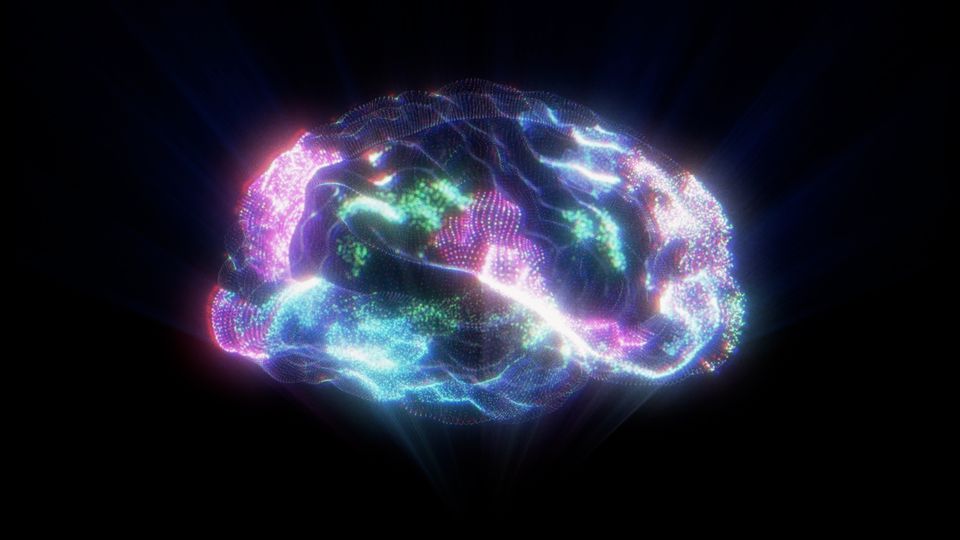
Losing your sense of self is a common part of a dimethyltryptamine (DMT) trip, but what actually happens in the brain when this occurs?
Researchers at Imperial College London and collaborators recorded brain activity under DMT and found that key brain rhythms shifted away from their usual balance.
DMT and the “ego death” experience
Psychedelics such as DMT have attracted scientific interest because they temporarily change how people experience the world. Many users report intense sensory changes and a fading sense of self, often called “ego dissolution” or “ego death.” Scientists are now studying these effects not just for their therapeutic potential, but also as a window into how the brain creates our sense of self.
Researchers have linked alpha waves – rhythmic brain activity between 8 and 13 hertz – to self-reflective thinking and maintaining an internal narrative. Neuroimaging studies with psilocybin, LSD and DMT found that brain activity becomes less predictable during psychedelic states.
One theory suggests that the brain normally functions in a balanced state between stability and randomness, known as “criticality.”
“The way the brain operates between chaos and order allows for normal brain function,” said senior author Dr. Christopher Timmerman, the co-director of the University College London Centre for Consciousness Research. “Criticality refers to a brain state balanced between chaos and order that helps us predict things about the environment, the way we change or adapt to it, and our self-awareness.”
Despite this, researchers still don’t fully understand how changes in criticality relate to ego dissolution, or whether changes in alpha waves consistently track shifts in the sense of self.
To understand how DMT alters the brain and contributes to ego death, Timmerman and the team analyzed electroencephalography (EEG) recordings from healthy volunteers.
Measuring brain activity under DMT
The team used recordings from 27 healthy adults who participated in 2 earlier placebo-controlled DMT studies. EEG activity was recorded before dosing and for 20 minutes after injection.
The team focused on three common brainwave types: theta, alpha and beta, and used two main measures:
- Detrended fluctuation analysis (DFA): estimates how brain activity is linked over time. Higher values suggest the brain is near the balance point between order and randomness.
- Excitation–inhibition ratio (EIR): indicates whether brain activity is shifting toward more excited or more inhibited states.
Participants also rated their experiences, including statements like “I experienced a disintegration of my sense of self.”
Compared with the placebo, DMT caused widespread reductions in DFA across theta, alpha and beta bands, especially alpha waves – indicating less structured and unpredictable brain activity. The excitation–inhibition ratio also dropped, particularly in areas associated with sensory processing.
The degree of these shifts correlated with self-reported ego loss. People who felt a stronger dissolution of self, showed larger reductions in theta and alpha measures.
“These findings have major implications for the understanding of psychedelic mechanisms of action in the human brain,” said the authors.
What the DMT findings mean for psychedelic research
The results hint that the brain’s sense of self may rely on staying close to a balanced operating state. In everyday consciousness, alpha-band activity appears to help sustain a continuous internal narrative over time. Under DMT, these waves become less organized, which may disrupt that narrative and the sense of self.

How Antibodies Reach Commercial Scale for Diagnostic Tests
This whitepaper follows an antibody's path to full production and shows where a contract partner can take on one step or the whole process.View Whitepaper
“We rely on past narratives and future predictions to have a coherent sense of self. In a DMT experience, people do not have a stream of consciousness over a period of time – everything takes place in the present moment. This shift in criticality signatures in the alpha frequency [during a DMT experience likely reveals how] the time-extended component of the sense of self is weakened,” explained co-author Dr. Marco Aqil, a postdoctoral researcher at the University of Miami.
The findings support the idea that psychedelics can act as tools for studying consciousness by temporarily altering the neural processes behind self-awareness.
However, the study also complicates existing theories, such as the entropic brain hypothesis. While brain activity became more unpredictable under DMT, it did not move toward a more excited state. Instead, alpha activity shifted toward a more inhibited, “subcritical” state.
Criticality remains a debated concept, and measures such as DFA and EIR rely on certain modeling assumptions. Alpha changes might also reflect vivid visual imagery, not just self-processing.
Future research could combine EEG with functional magnetic resonance imaging, study different doses and other psychedelics or explore clinical populations with altered self-processing.
Reference: Irrmischer M, Marco Aqil, Luan L, et al. DMT-induced shifts in criticality correlate with self-dissolution. JNeurosci. 2025. doi: 10.1523/JNEUROSCI.0344-25.2025
 Add Technology Networks as a preferred Google source to see more of our trusted coverage.


