Spatial mapping opens new avenues for biological discovery, providing the contextual insights needed to truly understand biological processes, disease mechanisms, and treatment opportunities. However, many spatial technologies are constrained by complex workflows, high computational burden, and resolution trade-offs.
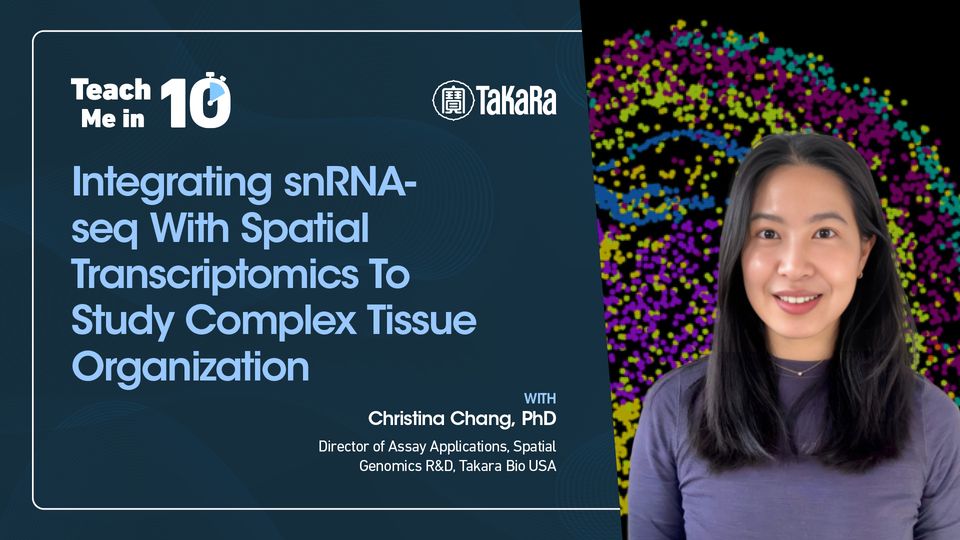
In this Teach Me in 10 episode, Dr. Christina Chang from Takara Bio USA introduces a new class of spatial technology for use with formalin-fixed paraffin-embedded (FFPE) samples. This workflow combines the sensitivity of single-cell NGS with precise localization of individual nuclei in tissue samples to illuminate cellular interactions, disease mechanisms, and therapeutic targets across complex tissue microenvironments. To explore an article based on this Teach Me in 10, see the resources linked below.
Watch this episode to explore:
- The challenges of current spatial methods
- How an instrument-free spatial profiling method provides true single-cell resolution
- Novel features of this spatial profiling method, including FFPE compatibility
Further Resources:
- Extracting spatial transcriptomics insights from FFPE with Trekker® FX: Read the article based on this Teach Me in 10
- Trekker® Single-Cell Spatial Mapping Kit: Reagent-only spatial omics solution that seamlessly integrates into standard single-cell sequencing workflows to transform genomics data into spatial data
- Spatial Biology Resources: Explore data generated by spatial omics solutions in product notes, webinars, and more